Ecommerce SEO in India: Trends and Practices
India's ecommerce market demands a mobile-first, multilingual SEO approach. Optimize for Indian shoppers, compete with marketplaces, and grow organic.
India's ecommerce market is massive and still growing fast
India's ecommerce market crossed $80 billion in 2024 and is projected to reach $200 billion by 2028 according to IBEF data. That growth rate makes it one of the fastest-expanding ecommerce markets in the world. And organic search is a major driver of that growth because Indian consumers are heavy Google users with distinct search behaviors.
What makes India different from Western ecommerce markets? The mobile-first reality is one factor. Over 95% of Indian internet users access the web primarily through smartphones. The price sensitivity is another. Indian shoppers compare prices aggressively and search queries reflect this ('best phone under 15000,' 'cheap running shoes online india'). Then there is the language diversity. India has 22 official languages and hundreds of millions of non-English internet users who search in Hindi, Tamil, Telugu, Bengali, and other regional languages.
Google dominates search in India with over 95% market share. Bing and Yahoo are nearly irrelevant. This simplifies your optimization target but increases the stakes: if you are not visible on Google India, you are invisible to Indian shoppers entirely. Google.co.in and google.com serve the same results for Indian users now, so there is no separate Indian Google algorithm to worry about. But geographic targeting, language preferences, and local search behavior all influence what results Indian users see.
We have worked with Indian D2C brands and international companies entering the Indian market. The SEO strategies that work in the US or Europe need significant adaptation for India. This guide covers what we have learned about making ecommerce SEO work in the Indian context.
Mobile-first optimization is non-negotiable
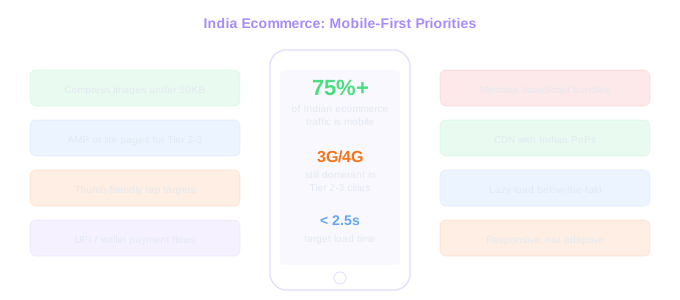
In Western markets, mobile optimization is a priority. In India, it is the entire game. According to StatCounter data, mobile accounts for over 78% of ecommerce traffic in India. In many categories, especially fashion and electronics, that number exceeds 90%. If your site does not work well on a mid-range Android phone with a 4G connection, you are losing the majority of your potential customers.
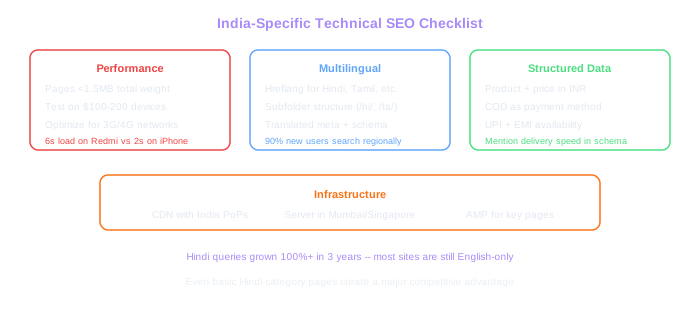
The typical Indian smartphone user has a device in the $100 to $200 price range with 3GB to 4GB of RAM. This is significantly less powerful than the flagship phones that Western developers test on. Pages that load in 2 seconds on an iPhone 15 might take 6 seconds on a Redmi or Realme device. Test your site on actual mid-range Android devices, not just Chrome DevTools throttling simulations.
Data costs have dropped in India (thanks to Jio's disruption of the telecom market), but many users still monitor their data usage. Heavy pages with large images, auto-playing videos, and excessive JavaScript consume data and frustrate users. Keep total page weight under 1.5MB for product pages. Use aggressive image compression, lazy loading, and consider implementing AMP (Accelerated Mobile Pages) for content pages if your site struggles with mobile performance.
Google's mobile-first indexing means the mobile version of your site is what Google uses for ranking and indexing. If your mobile site has less content, fewer internal links, or slower load times than your desktop version, your rankings will suffer. For Indian ecommerce specifically, we recommend building mobile-first and treating desktop as the adaptation rather than the other way around. Our guide on technical SEO for ecommerce covers the performance and crawlability foundations that support mobile-first rankings.
Test on Real Devices
The typical Indian smartphone costs $100-$200 with 3-4GB RAM. Pages loading in 2 seconds on an iPhone 15 may take 6 seconds on a Redmi device. Keep product pages under 1.5MB total weight.
Regional language SEO: reaching non-English shoppers
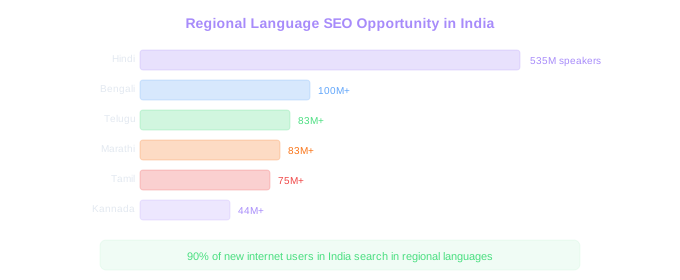
Google India supports search in over 10 Indian languages. Hindi internet users alone number over 600 million. Tamil, Telugu, Bengali, Marathi, and Gujarati each have tens of millions of internet users searching in their native language. Yet most Indian ecommerce sites are English-only. This represents a significant opportunity.
Hindi search queries related to ecommerce have grown by over 100% in the past 3 years. People search for 'saste running shoes' (cheap running shoes), 'best mobile phone hindi mein' (best mobile phone in Hindi), and product comparisons in their regional language. If your competitors are not optimizing for these queries, even basic Hindi-language content can capture meaningful traffic.
Start with Hindi for the broadest reach, then expand to languages that match your target market's geography. If you sell primarily in South India, Tamil and Telugu content will have more impact than Hindi. If your market is Western India, Marathi and Gujarati make sense.
Implementation options range from simple to complex. The simplest approach is creating Hindi (or other language) versions of your top-performing category pages and blog content. Use hreflang tags to tell Google which language version to serve to which users. More ambitious implementations involve full multilingual storefronts with translated product descriptions, navigation, and checkout flows.
A critical detail: do not rely on machine translation alone. Google Translate output reads unnaturally in Indian languages, and Indian users will notice. Hire native speakers to write or at least review your regional language content. The grammar structures, colloquialisms, and product terminology differ significantly from direct English translations.
Hindi Search Surge
Hindi ecommerce queries have grown over 100% in three years. Most Indian ecommerce sites are English-only, creating a major opportunity for stores that add even basic Hindi category pages and content.
Competing with Flipkart and Amazon India
Every ecommerce SEO strategy in India must account for the marketplace giants. Amazon India and Flipkart dominate search results for most product keywords. Searching for 'buy laptop online india' shows Amazon and Flipkart in the top 3 results nearly every time. Can a D2C or independent ecommerce store compete? Yes, but not on the same keywords.
Direct keyword competition with Amazon and Flipkart on broad product terms is usually futile for smaller stores. Their domain authority, content volume, and backlink profiles are nearly impossible to match. Instead, focus on keywords where marketplaces are weaker.
Long-tail and niche-specific keywords are your best opportunity. Amazon ranks well for 'wireless earbuds' but might not rank for 'wireless earbuds for small ears india' or 'best earbuds for bus commute.' These specific queries have lower volume but much higher conversion rates, and marketplaces rarely optimize their pages for them.
Brand-specific keywords are another area where D2C brands can win. If you build a recognizable brand, people will search for your brand name directly. 'Boat headphones' and 'Mamaearth skincare' are examples of Indian D2C brands that have built enough brand search volume to generate significant organic traffic independent of generic product keywords.
Content-driven SEO gives independent stores an advantage that marketplaces largely ignore. Amazon India does not publish buying guides, comparison articles, or educational content. By creating content that answers Indian shoppers' specific questions ('which AC is best for 100 sq ft room,' 'difference between ghee and butter for cooking'), you can capture traffic at the research stage and funnel it to your product pages.
Price-based keywords are extremely popular in Indian search behavior. Queries like 'best phone under 10000,' 'best laptop under 50000,' and 'best headphones under 2000' have enormous search volumes. Create dedicated landing pages and buying guides organized by price brackets. This is one area where D2C and niche stores can genuinely outrank Amazon because price-bracket content requires editorial judgment that marketplaces do not invest in.
Trust signals and payment optimization for Indian shoppers
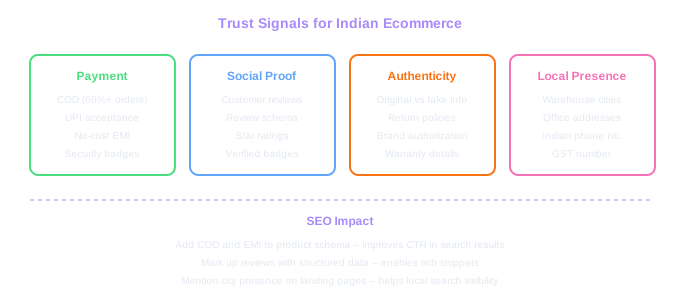
Indian online shoppers are cautious. Concerns about product authenticity, delivery reliability, and payment security influence both purchasing behavior and search behavior. Queries like 'is [brand] genuine,' '[store] review india,' and '[product] original vs fake' are common in India.
Your site needs visible trust signals that Google can also pick up on. Display customer reviews prominently and mark them up with schema. Show clear return and exchange policies. Display payment security badges. If you have physical locations or warehouses in India, mention the cities. Indian shoppers trust businesses with a verifiable local presence more than purely online operations.
Cash on Delivery (COD) remains a significant factor in Indian ecommerce. Over 60% of online orders in India still use COD as the payment method. Mentioning COD availability on your product pages and in your meta descriptions can improve click-through rates for Indian shoppers. Including 'Cash on Delivery available' in your product schema as a payment method property helps Google understand and display this information.
UPI (Unified Payments Interface) has transformed digital payments in India. Accepting UPI payments and mentioning it on your site is now a trust signal. Indian shoppers actively look for UPI payment options. Similarly, EMI (Equated Monthly Installment) options on higher-priced products are expected by Indian consumers. Highlighting 'No-cost EMI available' on product pages and in structured data can improve both SEO visibility and conversion rates.
Local SEO for D2C brands in India
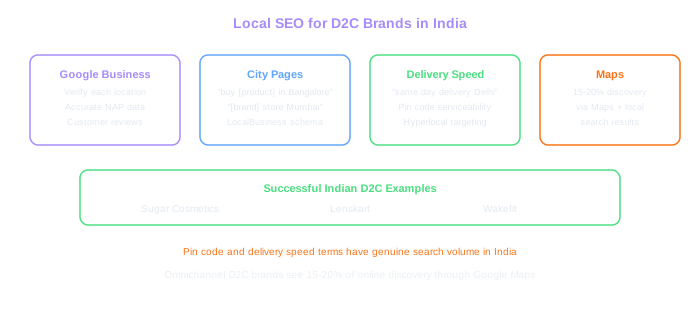
India's D2C (Direct-to-Consumer) market has exploded, with brands like Sugar Cosmetics, Lenskart, and Wakefit building significant businesses outside the marketplace ecosystem. For these brands, local SEO plays a role that is often overlooked.
If your D2C brand has physical touchpoints (stores, warehouses, experience centers, or even pop-up locations), Google Business Profile optimization drives both foot traffic and online credibility. Create and verify Google Business Profiles for each physical location. Keep hours, addresses, and phone numbers accurate. Encourage customer reviews on Google.
City-level landing pages work well for D2C brands that serve specific metros. Pages targeting 'buy [product] in Bangalore' or '[brand] store Mumbai' capture location-specific search intent. Combine these with local schema markup (LocalBusiness or Store schema) that includes your address, geo-coordinates, and service area.
Hyperlocal delivery has become a differentiator in Indian ecommerce. Brands offering same-day or next-day delivery within specific cities can highlight this in their SEO. Create content around delivery speed ('same day delivery in Delhi NCR,' 'next day delivery Hyderabad') because Indian shoppers actively search for fast delivery options. Pin codes and serviceability are search terms with genuine volume in India.
Google Maps integration matters for omnichannel D2C brands. When someone searches for your brand name + a city, Google often shows a Maps result. Having accurate Google Business Profiles ensures you appear there. We have seen D2C brands where 15% to 20% of their total online discovery comes through Google Maps and local search results.
Hyperlocal Delivery SEO
Indian shoppers actively search for fast delivery options by city. Creating content around 'same day delivery in Delhi NCR' and pin code serviceability captures genuine search volume that most competitors ignore.
Technical SEO considerations specific to India
Server location and CDN configuration matter more in India than in most markets because of the country's infrastructure diversity. Internet speeds vary dramatically between metros (Mumbai, Delhi, Bangalore) and tier-2 and tier-3 cities. A CDN with Points of Presence (PoPs) within India is not optional. Cloudflare, AWS CloudFront, and Google Cloud CDN all have Indian PoPs. Without one, your server response times for users in smaller cities can exceed 2 seconds before any page rendering even begins.
India's ccTLD is .in, and using it can provide a mild ranking advantage for India-specific searches compared to .com domains. However, most successful Indian ecommerce brands use .com with geographic targeting set to India in Google Search Console. The .in domain is most useful if your business operates exclusively in India. If you plan international expansion, stick with .com and use subdirectories (/in/) or subdomains (in.example.com) for India-specific content. Our international SEO service covers the hreflang, subdirectory, and targeting decisions that come with serving multiple markets.
Structured data for Indian ecommerce should include INR pricing (use the 'priceCurrency': 'INR' property), Indian delivery regions, and COD/UPI payment methods. Google Shopping in India reads this structured data, and accurate pricing in INR is required for your products to appear in Google Shopping results for Indian users. Use our schema generator tool to build correctly formatted product schema with INR currency and Indian-specific payment properties.
Core Web Vitals standards are the same globally, but achieving them in India requires more effort because of the device and network conditions. Target an LCP under 2.5 seconds on a 4G connection using a mid-range device. Minimize JavaScript execution time, which is the biggest performance bottleneck on lower-powered smartphones. Use the Chrome User Experience Report (CrUX) data filtered by India to see how your real users experience your site, rather than relying on lab data from developer machines.
India's internet regulations around data localization and privacy (the Digital Personal Data Protection Act passed in 2023) may affect how you handle user data, analytics, and personalization. While this does not directly impact SEO, ensuring compliance avoids legal risks that could disrupt your online operations. Store Indian users' personal data on servers located within India if your user base is primarily Indian.
Voice search is growing rapidly in India, driven by Google Assistant integration in affordable smartphones. Many Indian users prefer speaking search queries in Hindi or regional languages rather than typing in English. Optimizing for voice search means targeting natural-language, conversational queries and structuring your FAQ content to match how people actually speak. Queries like 'best water purifier for borewell water' reflect how Indian consumers use voice search to find products that solve specific local problems. For stores selling content-rich product categories, our guide on ecommerce SEO content covers how to build content that captures both typed and voice-driven queries.
Voice Search Is Rising
Many Indian users prefer speaking queries in Hindi or regional languages rather than typing in English. Optimize for natural-language, conversational queries and structure FAQ content to match how people actually speak.