How to choose the best ecommerce SEO agency
A practical guide to evaluating ecommerce SEO agencies. What makes them great at ecommerce, vetting questions, and how to measure performance.
Why ecommerce needs a specialist agency
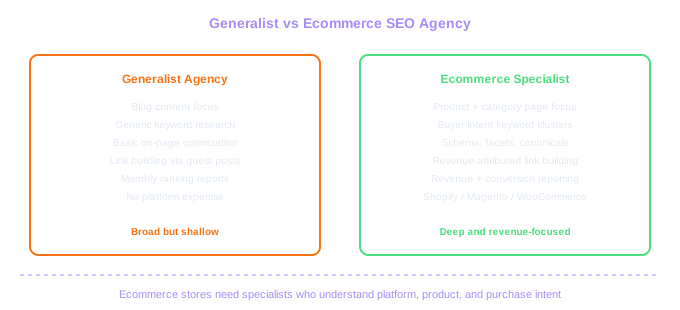
Most SEO agencies are generalists. They work with law firms, SaaS companies, restaurants, and ecommerce stores all at once. The problem is that ecommerce SEO has specific challenges that generalists often handle poorly.
A generalist agency might write great blog content but have no idea how to handle a Shopify store with 12,000 products generating 80,000 crawlable URLs through faceted navigation. They might know how to build links for a B2B company but struggle to create linkable content for an online store selling pet supplies.
We have rebuilt strategies from scratch for clients who spent 12 to 18 months with generalist agencies. In one case, a kitchenware brand had been paying an agency $4,000 per month for a year. The agency optimized blog posts, built some links, and sent monthly reports. They never touched the 8,400 product pages that had duplicate title tags, never fixed the canonical tag issues on category filter pages, and never addressed the 3,200 soft 404 errors. Organic traffic was flat the entire time.
When we took over, we started with the technical issues. Within four months, indexed pages increased by 40% and organic revenue grew by 28%. The difference was not talent. It was ecommerce-specific experience. Our technical SEO service covers the platform-level issues that most generalist agencies miss.
What makes an agency good at ecommerce specifically
Ecommerce SEO expertise shows up in specific areas that you can test during the vetting process.
Platform knowledge is the first indicator. A good ecommerce SEO company should have deep experience with the platform your store runs on. Shopify, Magento, WooCommerce, BigCommerce, and Salesforce Commerce Cloud each have distinct SEO quirks. Shopify automatically adds /collections/ to category URLs and handles canonicals in a specific way. Magento 2 has complex indexation issues with layered navigation. WooCommerce relies heavily on plugins that can conflict with each other. Ask the agency about your specific platform and listen for detailed, experience-based answers.
Scale management is the second indicator. Ecommerce stores operate at a scale that most websites do not. An agency needs processes for handling thousands of product pages, managing site-wide template changes, automating repetitive optimization tasks, and monitoring large keyword sets. Ask how they handle optimization when a store has 20,000 or more products. The answer should involve prioritization frameworks, template-level fixes, and data-driven approaches rather than page-by-page manual work.
Revenue orientation is the third indicator. The best ecommerce SEO agencies think in terms of revenue, not just traffic or rankings. They should talk about conversion rates, average order values, and revenue per session. When they prioritize keywords, they should factor in commercial intent and purchase likelihood, not just search volume.
Familiarity with ecommerce-specific technical challenges rounds out the list. Faceted navigation, product variant URLs, out-of-stock page management, seasonal inventory changes, structured data for products, and international multi-store setups are all ecommerce-specific issues that require specialized knowledge.
Questions to ask during the vetting process
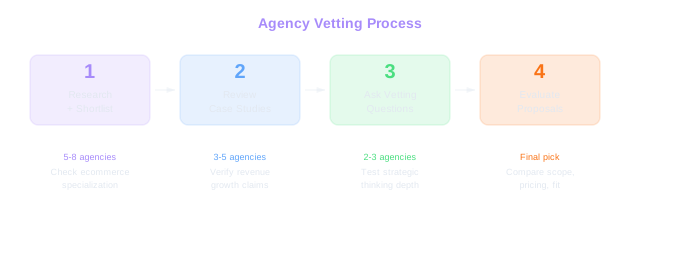
Beyond generic questions about experience and pricing, there are ecommerce-specific questions that separate qualified agencies from pretenders.
Ask them: how do you approach category page optimization? The answer should cover keyword research, content structure, internal linking, and how category pages fit into the broader site architecture. If they only mention meta tags and title tags, their approach is too shallow.
Ask: what is your process for handling a product catalog with seasonal inventory changes? This tests real-world ecommerce experience. Good agencies have established processes for handling out-of-stock products, seasonal category pages, and clearance sections without creating SEO problems.
Ask: can you show us a technical audit you did for an ecommerce site? You do not need the client's name, but the audit itself should show the depth of their technical analysis. Look for coverage of crawl budget, indexation analysis, structured data validation, Core Web Vitals, and mobile performance. If their audit is five pages of surface-level observations, that is all you will get.
Ask: how do you build links for ecommerce sites? This is hard to do well for online stores. Product pages rarely attract organic links. The agency should describe strategies like creating linkable content (guides, tools, original research), leveraging supplier and manufacturer relationships, digital PR, and broken link building. If their link building strategy is guest posting on generic blogs, the links will have minimal impact. For context on what a strong ecommerce off-page strategy looks like, read our guide on off-page SEO for ecommerce.
Ask: what is your reporting process and what metrics do you prioritize? Revenue, organic traffic segmented by page type, conversion rate, and ranking progress should all be mentioned. If their reporting focuses on domain authority growth or number of links built without tying to business metrics, their priorities are misaligned with yours.
Key Vetting Question
Ask agencies how they handle seasonal inventory changes. This single question tests real ecommerce experience -- generic SEO agencies rarely have processes for out-of-stock products or seasonal category pages.
Evaluating portfolios and case studies
Case studies are the closest thing to proof of competence in SEO. But you need to read them critically.
Good case studies include specific starting conditions (traffic, revenue, technical state), specific actions taken, specific results with timeframes, and context about the competitive environment. '150% organic revenue growth in 12 months' is meaningless without knowing the starting point, the market, and what work was done.
Look for case studies in your industry or adjacent industries. An agency that has grown organic revenue for five different apparel brands is a stronger candidate for your clothing store than one whose best case study is a B2B software company.
Pay attention to the timeframes. If every case study shows results in 3 months, either the agency cherry-picks easy wins or inflates numbers. Real ecommerce SEO results for competitive niches take 6 to 12 months to materialize. Case studies that honestly show a 4-month period of flat results followed by accelerating growth are actually more credible.
Ask about failures too. Every agency has had clients where things did not work out. How they discuss those situations tells you a lot. An agency that claims a 100% success rate is lying. One that can explain what went wrong, what they learned, and how they adjusted is demonstrating maturity and honesty.
We lost a client once because we underestimated the impact of a competitor's aggressive content strategy in their niche. Our technical and on-page work was solid, but we did not invest enough in content early enough. The client left after 8 months. We learned from it and now front-load content strategy in our engagements for competitive niches. That is the kind of honest reflection you should look for in an agency partner.
Understanding contracts and engagement terms
Agency contracts deserve careful attention. The terms reveal how confident an agency is in their own work.
Contract length is the first thing to examine. Month-to-month agreements give you maximum flexibility but offer the agency no security, which can affect how much they invest in your account upfront. Three-month initial commitments are reasonable because SEO needs time. Six-month contracts are acceptable if the agency offers clear milestones and exit clauses. Twelve-month lock-ins with no performance provisions should make you nervous.
Look for performance benchmarks or exit clauses. The best agencies build in milestones: if after 6 months, specific metrics have not improved, you can terminate without penalty. This shows confidence in their ability to deliver. If the contract has no performance-related provisions and the only exit is paying the remaining balance, the agency is prioritizing their revenue over your results.
Understand what you own. Content created for your site should belong to you. Strategies and recommendations should belong to you. Some agencies include clauses that retain ownership of work product, which means if you leave, you cannot use the content or strategies they developed. Read these clauses carefully.
Check the scope boundaries. What is included in the monthly retainer and what costs extra? Content creation, link building, and development work are the most common add-on charges. If the base package does not include content but the strategy depends on publishing new content monthly, you need to factor in those additional costs. Our guide on ecommerce SEO pricing gives you a detailed breakdown of what agencies typically charge and how to evaluate whether a retainer is good value.
Payment terms vary. Most agencies invoice monthly, some quarterly. Net-30 payment terms are standard. Be cautious of agencies that require full payment upfront for extended periods.
Communication and collaboration expectations
The working relationship with your agency matters as much as their technical skills. Poor communication is the number one reason agency-client relationships break down.
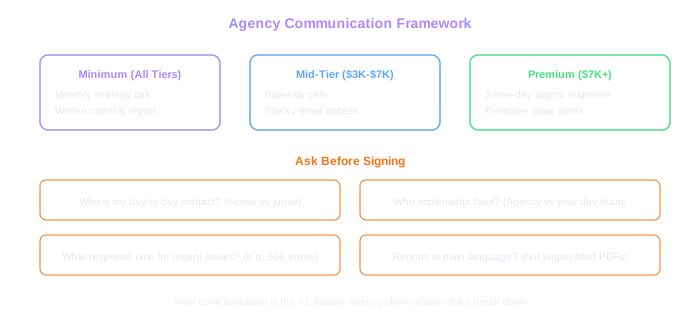
Establish communication cadence before signing. At minimum, you should have a monthly strategy call, a written monthly report, and a responsive channel for questions between calls (email or Slack). For mid-tier and premium engagements, biweekly calls and same-day response times for urgent issues should be standard.
Ask who your main contact will be. In many agencies, a senior person handles the sales process but hands you off to a junior account manager after you sign. This is not inherently bad if the junior person is competent and supported by seniors. But you should know upfront. Ask to meet the person who will actually manage your account before you commit.
Understand how implementation works. Some agencies handle all technical implementation themselves. Others provide recommendations and expect your development team to implement them. Both models can work, but you need clarity. If the agency sends you a list of technical fixes and your developer has no idea what to do with them, progress stalls.
Reporting should be transparent and comprehensible. If you receive a report full of jargon that you cannot understand, the agency is not communicating well. Reports should explain what happened, why it matters, and what comes next in plain language. Data should be visualized clearly with year-over-year comparisons to account for seasonality.
Set expectations about response times for different request types. A broken page returning 500 errors needs same-day attention. A question about keyword strategy can wait a few days. Having these expectations aligned prevents frustration on both sides.
Meet Your Contact
Many agencies use senior people for sales but hand you off to a junior account manager. Ask to meet the person who will actually manage your account before you commit.
How to measure your agency's performance
Once you have hired an agency, you need to evaluate whether they are delivering value. Here is how we recommend clients measure our own performance, and it applies to any ecommerce SEO firm.
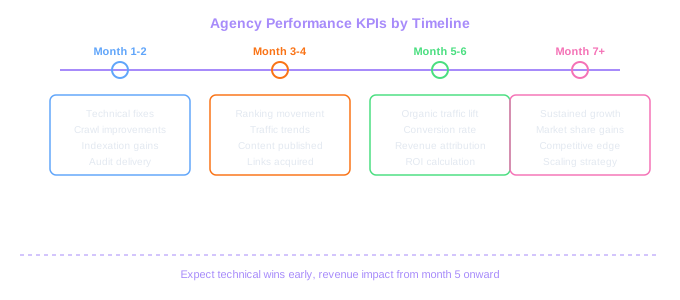
The primary metric is organic revenue. Track it monthly, compare year-over-year, and break it down by page type (category, product, content, other). The agency should be able to explain the trend and connect it to their work. If organic revenue is growing, the investment is working. If it is flat or declining after 6 months, the agency needs to explain why and adjust their approach.
Organic traffic is a secondary metric. It is a leading indicator that revenue typically follows, but traffic alone is not success. We have seen agencies celebrate traffic increases driven by blog content that attracted the wrong audience and converted at near-zero rates. Always look at traffic in the context of revenue.
Keyword rankings show progress at a granular level. Track a core set of 30 to 50 commercial keywords. Upward movement across this set, even if individual keywords fluctuate, indicates that the overall strategy is working. If after 6 months there is no directional improvement in rankings, something is off.
Technical health metrics should improve quickly. Indexation rates, crawl errors, and Core Web Vitals should show measurable improvement within the first two to three months. These are leading indicators that the foundation is being fixed.
The metric that ties everything together is organic revenue as a share of total revenue. A good ecommerce SEO agency should move this number upward over time, reducing your dependence on paid channels and improving your overall marketing efficiency. We target a minimum of 30% organic revenue share for our clients within the first 18 months.
Warning signs after you have started working together
Some problems only become visible after the engagement is underway. Watch for these warning signs.
Excuses without data. If the agency consistently explains away poor results without showing data to support their explanations, they are covering up underperformance. 'Traffic is down because of an algorithm update' is a valid explanation if accompanied by industry data showing the same trend. Without that context, it is an excuse.
Deliverable delays. Occasional delays happen. Consistent delays mean the agency is overcommitted or disorganized. If reports are late every month and tasks slip from one month to the next regularly, the work is not being prioritized.
Lack of proactivity. A good agency should bring you ideas and insights you did not ask for. If every interaction is reactive (they only act when you ask), they are not invested in your growth. They should be monitoring your site, watching competitor movements, and suggesting opportunities without being prompted.
Template-based work. If the recommendations you receive look generic and could apply to any ecommerce store, the agency is not doing custom work. Content briefs should reference your specific products and categories. Technical recommendations should address your specific platform issues. One-size-fits-all strategies deliver one-size-fits-all results, which means mediocre.
Opacity about link building. If you ask where your backlinks are coming from and the agency is evasive or reluctant to share, they may be using tactics that could hurt you. Every link built should be disclosed and defensible. You should be able to look at each linking site and feel comfortable that it is a legitimate, relevant source.
If you see multiple warning signs, raise them directly with the agency. A good agency will acknowledge the issues and fix them. If they get defensive or dismissive, start planning your exit. If you are considering switching to a solo expert instead, read our guide on working with an ecommerce SEO consultant to understand the tradeoffs.
Exit Planning
If reports are consistently late, recommendations look generic, and the agency cannot show where your backlinks come from, start planning your exit. A good agency acknowledges problems and fixes them -- defensive responses confirm the red flags.