Ecommerce SEO Pricing: Costs, Value, and ROI
Understand ecommerce SEO pricing models, typical cost ranges, and what drives value. Evaluate proposals and avoid overpaying for underdelivery.
Why ecommerce SEO pricing varies so much
Ask five agencies what ecommerce SEO costs and you will get five wildly different answers. We have seen quotes range from $500/month to $25,000/month for stores that look similar on the surface. The variation is not random. It reflects real differences in scope, expertise, and what is actually included.
Ecommerce SEO pricing depends on your store size, competitive environment, current technical health, and what outcomes you need. A 200-product Shopify store competing in home decor has different needs than a 50,000-SKU electronics retailer going up against Amazon and Best Buy. Pricing should reflect those differences. When it does not, someone is either overcharging or cutting corners.
We wrote this breakdown because pricing conversations in our industry are often vague on purpose. Agencies benefit from opacity. We think store owners deserve better. Here is what actually drives ecommerce SEO costs and how to figure out whether a proposal is worth the investment. If you want to see what deliverables each price tier buys, read our breakdown of ecommerce SEO packages.
The three main pricing models
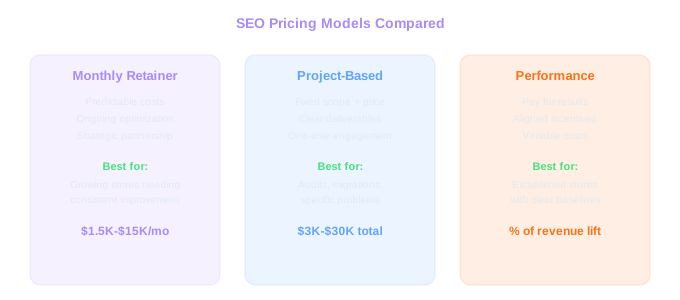
Monthly retainers are the most common model for ecommerce SEO. You pay a fixed amount each month, and the agency handles an agreed-upon scope of work. Retainers typically range from $2,000 to $15,000 per month for mid-market stores. The advantage is predictable budgeting and ongoing optimization. The downside is that you are locked in, and some agencies coast after the first few months when the initial enthusiasm fades.
Project-based pricing works for specific initiatives. A technical SEO audit might cost $3,000 to $8,000. A full site migration could run $10,000 to $30,000 depending on complexity. Category page overhauls, content strategy buildouts, and link-building campaigns also fit this model. You get a defined deliverable with a clear start and end date. This works well when you have an in-house team that can execute but needs expert direction.
Performance-based pricing ties fees to results. Sounds appealing, but it comes with serious caveats. Agencies using this model often cherry-pick easy wins, avoid risky-but-valuable work, or define success metrics that flatter their efforts. We have seen performance contracts where the agency took credit for branded traffic increases that had nothing to do with their work. If you go this route, make sure the metrics are specific, verifiable, and tied to non-branded organic revenue.
What affects your ecommerce SEO cost
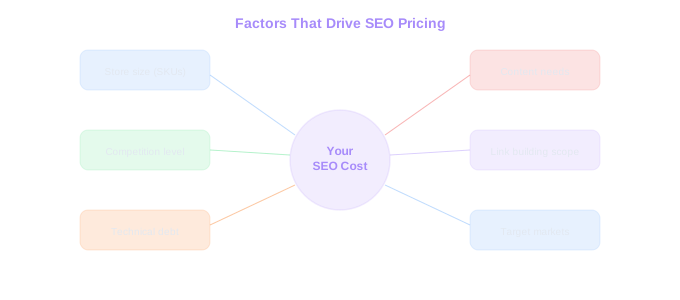
Store size is the most obvious factor. A store with 500 products needs different technical attention than one with 80,000. More pages mean more crawl budget concerns, more potential for duplicate content, more internal linking decisions, and more metadata to manage. We typically see costs increase by 30-50% when moving from stores with under 1,000 pages to those with 10,000+.
Competitive intensity matters just as much. Selling handmade ceramics online is a different game than selling running shoes. The running shoe store competes with Nike, Adidas, Zappos, and dozens of well-funded competitors who have been investing in SEO for a decade. More competitive niches require more link building, more content production, and more sophisticated technical work. That costs more.
Your store's current technical health plays a role too. A site with clean architecture, proper canonicalization, and fast load times needs less remediation work upfront. A site with thousands of duplicate pages, broken internal links, and a 6-second load time needs significant foundational work before any growth strategy makes sense. That initial cleanup can add $5,000 to $15,000 to the first few months.
Platform complexity also affects pricing. Shopify stores are generally simpler to work with than Magento 2 or custom-built platforms. On Shopify, implementing structured data or fixing URL structures follows well-documented patterns. On a custom platform, every change might require development time at $150-200/hour. We have worked on projects where 40% of the budget went to implementation rather than strategy, purely because of platform limitations.
Platform Cost Gap
Shopify SEO implementations follow well-documented patterns. Custom platforms can consume 40% of the total SEO budget on dev work alone, at $150-200/hour for implementation.
Typical price ranges and what you get
At the $1,000-3,000/month level, you are getting basic SEO maintenance. This usually includes monthly reporting, some on-page optimization, and limited content work. For a small store with low competition, this can be enough. But at this budget, do not expect aggressive link building or deep technical work. Most agencies at this price point are running a volume model with many clients per account manager.
The $3,000-8,000/month range is where meaningful ecommerce SEO happens for most stores. At this level, you should expect a dedicated strategist, regular technical audits, ongoing content creation (4-8 pieces per month), some link-building activity, and monthly strategy calls. This is the sweet spot for stores doing $500K to $5M in annual revenue that want to grow organic as a serious channel.
Above $8,000/month, you are in territory where agencies provide senior-level strategists, custom reporting dashboards, dedicated development resources, aggressive content programs, and proactive link-building campaigns. This makes sense for stores doing $5M+ in revenue or operating in extremely competitive categories. At one client in the supplement space, we allocated $4,000/month purely to link acquisition because their competitors were spending similar amounts.
One-time projects have their own ranges. A technical audit runs $2,500-8,000. Keyword research and content strategy documents cost $3,000-6,000. Site migration planning and execution ranges from $8,000 to $30,000 depending on the number of URLs and complexity of the redirect mapping.
How to evaluate value versus cost
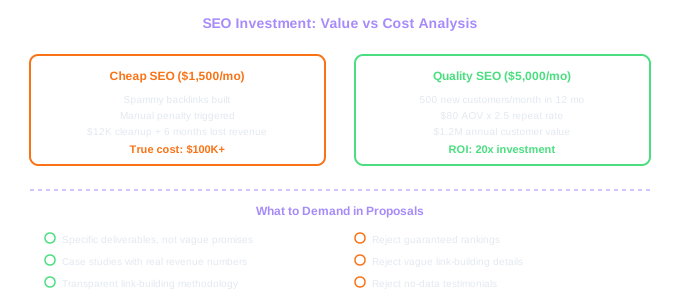
The cheapest option is rarely the best value. We have taken over accounts from budget agencies where the previous work actually hurt rankings. One store came to us after a $1,500/month agency built hundreds of spammy backlinks that triggered a manual penalty. Cleaning that up cost $12,000 and six months of lost revenue. The "savings" from the cheap agency ended up costing over $100,000 in total.
Start by calculating your customer lifetime value and organic revenue potential. If your average order is $80, your repeat purchase rate is 2.5x per year, and SEO could realistically bring in 500 new customers per month within 12 months, the math on a $5,000/month investment makes obvious sense. That is $1.2M in annual customer value against $60K in SEO spend.
Ask agencies for specific deliverables, not vague promises. "We will optimize your site" tells you nothing. "We will audit and fix technical issues across your 2,000 product pages, create 6 buying guides targeting commercial keywords, and build 15 high-authority backlinks per month" gives you something to measure against. If an agency cannot be specific about what they will do, they probably do not have a clear plan. It is also worth consulting an ecommerce SEO consultant for an independent perspective before signing.
Look at case studies with actual numbers. Revenue increases, traffic growth percentages, and specific ranking improvements tell you what an agency has done for similar stores. Testimonials without data are marketing fluff. We publish our client results with real metrics because we think the work should speak for itself. You can also research the landscape of ecommerce SEO agencies to benchmark what good looks like.
Red flags in ecommerce SEO proposals
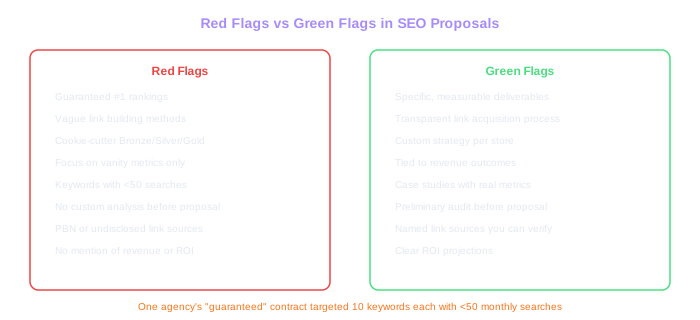
Guaranteed rankings are the biggest red flag. No agency can guarantee a #1 position on Google. Anyone who promises this is either lying or planning to target keywords so obscure that ranking for them has zero business impact. We once reviewed a competitor's "guaranteed results" contract. They guaranteed page-one rankings for 10 keywords. Every single keyword had fewer than 50 monthly searches.
Lack of transparency about link-building methods should concern you. If the proposal mentions link building but gives no detail about how links will be acquired, the agency might be buying links from PBNs (private blog networks) or using other tactics that violate Google's guidelines. Ask directly: where do the links come from? If the answer is evasive, walk away.
Cookie-cutter packages with no customization suggest the agency treats all stores the same. Your store has specific technical issues, unique competitive dynamics, and particular content opportunities. An agency that offers the same Bronze/Silver/Gold packages to every prospect is not doing the analysis required to build a real strategy.
Watch for proposals that focus heavily on vanity metrics. Rankings for informational keywords, total number of backlinks, or domain authority increases sound impressive in reports but may not move revenue. The best proposals tie activities directly to business outcomes: organic revenue growth, conversion rate improvements on organic traffic, and market share in your category.
When cheap SEO ends up costing more
We see a pattern repeatedly. A store owner hires a cheap SEO provider, usually offshore or a solo freelancer at $500-1,000/month. For six months, they receive monthly reports showing keyword rankings and traffic numbers. Some of those numbers even go up. Then something changes.
Maybe Google releases a core update and the site drops because the "optimization" was all thin, templated content. Maybe the backlinks start getting deindexed because they came from link farms. Maybe the site's technical health degrades because nobody was monitoring crawl errors or fixing broken pages. The store owner now has less organic traffic than when they started, plus they have spent six months of budget with nothing to show for it.
One retailer we work with spent 14 months with a budget agency before coming to us. In that time, their organic revenue actually declined by 22%. When we audited the work, we found duplicate title tags across 800+ pages, keyword-stuffed product descriptions that hurt conversion rates, and a disavow file that had accidentally blocked legitimate referring domains. The total cost of the cheap agency plus our remediation work exceeded what 14 months of proper SEO would have cost from the start.
This is not an argument for always choosing the most expensive option. It is an argument for choosing agencies that can explain their methodology, show relevant experience, and provide clear deliverables. Sometimes a $3,000/month agency does better work than a $10,000/month one. Price alone does not determine quality. But suspiciously low prices almost always indicate corners being cut.
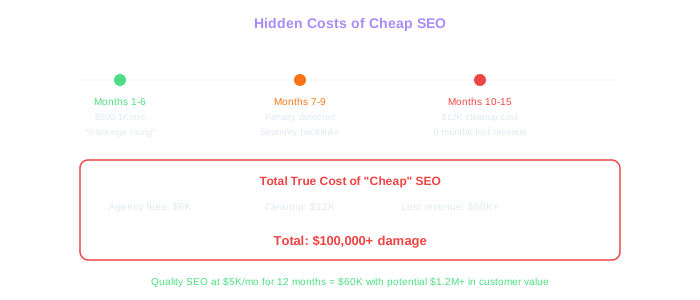
Cheap Gets Expensive
One retailer spent 14 months with a budget agency and saw organic revenue decline 22%. The total cost of the cheap agency plus remediation exceeded what proper SEO would have cost from the start.
How to structure your SEO budget over time
Most ecommerce stores benefit from a front-loaded investment. The first 2-4 months involve more work because of technical audits, competitive analysis, content strategy development, and initial optimization. After that foundation is set, monthly costs can stabilize or even decrease slightly as the focus shifts to execution and iteration.
We recommend allocating budget in phases. Phase one (months 1-3) handles the audit, fixes critical technical issues, and builds the keyword and content strategy. This phase often costs 20-40% more than ongoing months. Phase two (months 4-8) focuses on content production, link building, and implementing the strategy. Phase three (months 9+) is optimization, testing, and scaling what works.
Plan for at least 6-12 months of investment before expecting significant returns. SEO is not instant. Stores that commit to 12 months of consistent work almost always see positive ROI. Stores that quit after 3 months because they have not seen results yet waste whatever they have already spent. The compounding nature of SEO means the biggest gains often come in months 8-14.
Set aside 10-15% of your total SEO budget for tools and technology. Rank tracking, crawling software, and analytics platforms are necessary expenses. Some agencies include these in their pricing. Others do not. Clarify this upfront so you are comparing proposals accurately.
Getting the most from your investment
The stores that get the best ROI from SEO spending are the ones that treat their agency as a partner, not a vendor. Share your sales data, upcoming promotions, and product launch schedules. The more context your SEO team has, the better they can align their work with your business goals.
Hold your agency accountable to specific metrics. Organic revenue (non-branded), organic conversion rate, and keyword visibility in your target categories are the metrics that matter. Review these monthly. If the trend is not moving in the right direction after 6 months, have an honest conversation about what needs to change.
Make sure you have the internal resources to implement recommendations. The most expensive and frustrating scenario is paying an agency for strategy that never gets executed because your dev team has a 3-month backlog. If implementation capacity is limited, factor that into your agency selection. Pick a partner who can handle execution, not just strategy. It will cost more upfront but will actually produce results. A good starting point is booking a professional SEO audit to identify exactly where your budget should go first.