Advanced SEO
14 min readAI Search Optimization
AI-powered search engines like Google's AI Overviews, ChatGPT, Perplexity, and Bing Copilot are fundamentally reshaping how consumers discover and evaluate products. For ecommerce brands, appearing in these AI-generated answers means rethinking [content strategy](/academy/content-strategy-for-stores) beyond traditional keyword rankings to focus on entity authority, structured data clarity, and content that machines can confidently cite.
In this guide
How AI Search Engines Source Ecommerce Answers
AI search engines do not simply crawl and rank pages the way traditional search does. They ingest, parse, and synthesize content from multiple sources to generate a single cohesive answer. When a shopper asks an AI assistant 'what is the best waterproof hiking boot under $200,' the model evaluates dozens of pages, extracts product attributes, cross-references reviews, and assembles a response that may cite three or four sources. Your product page needs to be one of those cited sources.
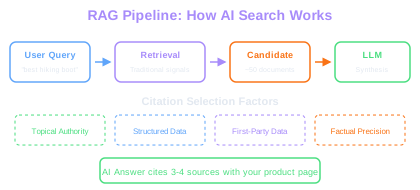
The selection process favors pages that provide clear, well-structured, factual information. AI models assess content along several dimensions: topical authority of the domain, consistency of product claims across the web, structured data completeness, and the presence of unique first-party data such as original testing results or proprietary specifications. Pages that simply rehash manufacturer descriptions without adding unique value are rarely selected as citation sources.
Understanding the retrieval-augmented generation (RAG) pipeline is essential. Most AI search systems first retrieve a set of candidate documents using traditional search signals, then feed those documents into a language model that synthesizes the final answer. This means you still need strong traditional SEO fundamentals like crawlability, page speed, and relevant backlinks to make it into the candidate pool. But once in the pool, content quality, structure, and factual precision determine whether you get cited.
RAG Pipeline
Most AI search systems retrieve 50+ candidate documents using traditional SEO signals, then a language model selects 3-4 sources to cite. Strong crawlability and backlinks get you into the pool; content quality gets you cited.
Structuring Product Content for AI Extraction
AI models extract information most reliably when content is organized in clear, parseable patterns. For ecommerce, this means structuring product pages so that key attributes like price, availability, specifications, comparisons, and use cases are explicitly stated rather than buried in marketing prose.
Create dedicated specification sections with clearly labeled attributes. Instead of weaving the weight of a laptop bag into a paragraph, present it as 'Weight: 1.2 kg (2.6 lbs)' in a structured format. AI models parse tabular and list-format data far more accurately than extracting facts from flowing text. Every quantifiable product attribute should appear in both human-readable format and schema markup.
FAQ sections on product pages serve a dual purpose: they answer shopper questions directly and they create structured question-answer pairs that AI models can extract with high confidence. Focus FAQs on genuine purchase-decision questions like compatibility, sizing, warranty terms, and comparison with alternatives rather than generic filler questions.
Category pages should include concise, authoritative buying guides that define the product category, explain key differentiating attributes, and provide decision frameworks. When an AI model needs to answer 'what should I look for in a trail running shoe,' it prefers pages that systematically explain cushioning types, drop measurements, outsole compounds, and fit considerations over pages that simply list products.
Create a 'Key Specs' summary block at the top of every product page listing the 5-8 most decision-relevant attributes in a consistent label:value format. AI models extract these summary blocks with significantly higher accuracy than information scattered across long descriptions.
Schema Markup Strategies for AI Visibility
Structured data has always been important for ecommerce SEO, but AI search engines rely on schema markup even more heavily than traditional search to understand product attributes, availability, pricing, and relationships. Comprehensive schema implementation is no longer optional for stores that want AI visibility.
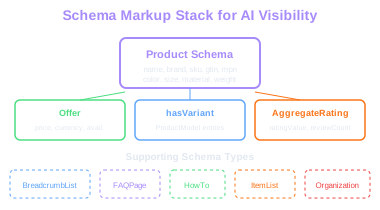
Product schema should include every available property: name, description, brand, sku, gtin, mpn, color, size, material, weight, and any category-specific attributes. The more explicit and complete your product markup, the more confidently an AI model can extract and cite your product information. Do not rely on AI to infer attributes that you could explicitly declare.
Implement the Offer schema nested within Product to specify price, priceCurrency, availability, priceValidUntil, and seller. For products with multiple variants, use the hasVariant property to link to individual ProductModel entries, each with their own complete attribute set. AI models struggle with pages that show variant-dependent pricing without clear structured data mapping.
Beyond individual products, use BreadcrumbList for navigation context, FAQPage for question-answer content, HowTo for usage guides, and Review/AggregateRating for social proof signals. ItemList schema on category pages helps AI models understand your product taxonomy and the relationships between items.
Test your schema implementation regularly using Google's Rich Results Test and Schema.org's validator. AI models process your markup directly, so errors, missing fields, or outdated information in schema can cause your products to be excluded from AI-generated recommendations.
Schema Completeness
Include every available Product property: name, brand, sku, gtin, mpn, color, size, material, weight. The more explicit your markup, the more confidently AI models extract and cite your product data.
Implement SameAs links in your Organization schema pointing to your official social media profiles, Wikipedia page, and Wikidata entity. This helps AI models connect your website to your broader entity graph and increases confidence in your brand identity.
Content Depth and Topical Coverage
AI search engines prefer citing sources that demonstrate comprehensive topical expertise rather than thin pages targeting individual keywords. For ecommerce, this means building content hubs around your product categories that cover every angle a potential buyer might research.
A store selling espresso machines should not just have product pages. It should maintain a content ecosystem covering espresso machine types (semi-automatic vs. automatic vs. manual), grinder compatibility, water quality and descaling, milk frothing techniques, bean selection guides, troubleshooting common issues, and maintenance schedules. This topical coverage signals to AI models that your site is an authoritative source for espresso-related queries.
Comparison content is particularly valuable for AI citation. When AI models answer questions like 'Breville Barista Express vs. Gaggia Classic Pro,' they need sources that objectively compare both products with structured attribute-by-attribute analysis. Create comparison pages with consistent frameworks: price, build quality, ease of use, grind quality, steam power, footprint, and long-term cost of ownership.
Original research and proprietary data earn disproportionate citation frequency. If you can publish original testing data, survey results, or usage statistics that no other source has, AI models will preferentially cite your content because it provides unique information they cannot synthesize from other sources. Even simple data like 'based on our analysis of 10,000 customer orders, the average espresso machine lifespan is 6.3 years' gives AI models a reason to cite your page.
Monitoring AI Search Performance
Tracking your visibility in AI search results requires new tools and methodologies beyond traditional rank tracking. AI responses are dynamic, personalized, and often do not include clickable links, making measurement fundamentally different from monitoring SERP positions.
Use tools designed for AI search monitoring such as Ottimo, Profound, or specialized features within platforms like Semrush and Ahrefs that track AI Overview appearances. These tools query AI systems with your target keywords and record whether your brand or URLs appear in the generated responses. Track citation frequency, positioning within the response, and sentiment of how your products are described.
Monitor your referral traffic from AI platforms separately in analytics. Create UTM-tagged landing pages or use referrer analysis to identify visits originating from ChatGPT, Perplexity, Bing Copilot, and Google AI Overviews. This traffic often has different behavior patterns than traditional organic traffic: higher engagement, longer session duration, but potentially lower volume per query.
Conduct regular manual audits by querying AI assistants with your most important commercial keywords and evaluating the responses. Note which competitors are being cited, what product attributes are highlighted, and where your content gaps exist. These audits reveal optimization opportunities that automated tools might miss.
A/B test content changes by modifying product page structures, adding or removing schema properties, and updating FAQ content, then monitoring whether your AI citation frequency changes over subsequent weeks. AI models update their training data and retrieval indexes at varying intervals, so allow adequate time for changes to propagate.
Set up automated alerts for branded queries in AI search tools. If a competitor suddenly starts appearing in AI responses for your brand name queries, it signals a potential authority or content gap you need to address immediately.
Free Tools & Resources
Try our free SEO tools
Work Together With SEO Experts who understand ecommerce
World’s first Ecom-founded SEO agency