Measuring Results
10 min readSEO Task Planning for Ecommerce
Most ecommerce SEO teams stay busy without making progress. They fix random technical issues, publish blog posts on whatever topic comes to mind, and chase every algorithm update rumor. Six months later, organic traffic looks about the same. The difference between teams that move the needle and teams that spin their wheels comes down to task planning: picking the right five tasks instead of grinding through forty mediocre ones.
In this guide
Impact vs. Effort: Stop Doing Everything at Once
A 500-SKU store has hundreds of possible SEO improvements at any given time. Broken internal links, missing alt tags, thin product descriptions, slow category pages, unoptimized title tags, no schema markup on half the catalog. The instinct is to start a giant spreadsheet and work through it line by line. That approach guarantees you spend weeks on tasks that barely move revenue.
Focus matters more than volume. Rewriting the title tags and meta descriptions on your top 20 revenue-generating category pages will almost certainly produce more organic traffic growth than fixing 200 missing alt tags on archived blog images. Both are valid SEO work, but they sit in completely different impact tiers. The alt tag fixes might take the same total hours, yet produce a fraction of the traffic gain.
A practical test: before starting any task, ask what happens if this works perfectly. If the answer is a measurable increase in impressions, clicks, or revenue on pages that actually matter to the business, it belongs near the top of the list. If the best-case outcome is marginal or affects pages with negligible traffic, it can wait.
This does not mean you ignore small fixes forever. It means you batch them into low-priority maintenance sprints instead of letting them consume your primary work hours. Your high-impact tasks get protected time every single week.
Pull your top 50 landing pages by organic revenue from GA4. Any SEO task that directly improves one of these pages gets automatic priority over tasks targeting pages outside this list.
The Impact-Effort Matrix for Ecommerce SEO
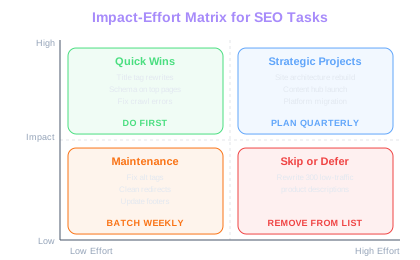
Plot every SEO task on a two-by-two grid. The vertical axis is impact: how much traffic or revenue growth this task can realistically produce. The horizontal axis is effort: how many hours, how many people, and how many dependencies are involved. This gives you four quadrants that dictate your execution order.
High impact, low effort: these are your quick wins and they should be done first. Examples include adding structured data to your top category pages, fixing crawl errors on high-traffic URLs, updating title tags on product pages that rank positions 4-10 for high-volume keywords, and compressing oversized images on your homepage. A store selling outdoor gear might notice their "hiking boots" category page ranks position 7 for a 12,000 monthly search volume keyword with a generic title tag. Rewriting that title tag takes 10 minutes and could push the page up 2-3 positions.
High impact, high effort: these are strategic projects that need proper planning. Rebuilding your site architecture, launching a content hub around your core product categories, or migrating to a faster hosting setup. These go into your quarterly roadmap with clear milestones.
Low impact, low effort: batch these into maintenance sprints. Fixing alt tags, cleaning up redirect chains, updating copyright years in footers. Do them, but never at the expense of higher-impact work.
Low impact, high effort: question whether these belong on the list at all. Rewriting 300 product descriptions that get 5 visits per month each, or building a complex filtering system for a category with minimal search demand. Often the right answer is to skip them entirely.
10-Minute Win
Rewriting a generic title tag on a category page ranking position 7 for a 12,000-search keyword takes 10 minutes and can push it up 2-3 positions. That single quick win may generate more traffic than fixing 200 alt tags.
When scoring effort, include dependencies. A title tag change that needs approval from the brand team, legal review, and a developer deployment is not a low-effort task regardless of how simple the actual writing is.
Building an SEO Sprint System
Borrowing sprint methodology from product development works well for SEO because it forces you to commit to specific deliverables within fixed timeframes instead of maintaining an ever-growing to-do list that never gets finished.
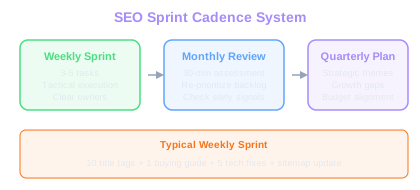
Weekly sprints handle tactical execution. Each Monday, pick 3-5 tasks from your prioritized backlog. These should be completable within the week by the people available. A typical weekly sprint for a mid-size ecommerce store might include: optimize title tags and descriptions for 10 category pages, publish one buying guide targeting a specific keyword cluster, fix the 5 highest-priority technical issues from your last crawl report, and submit updated sitemaps after product catalog changes.
Monthly cycles handle review and adjustment. At the end of each month, review what got done, what the early performance signals look like, and what needs to shift. If you spent the last month optimizing category pages and impressions for those pages are climbing in Search Console, you have validation to continue. If nothing moved, dig into why before repeating the same approach.
Quarterly planning handles strategic direction. This is where you decide the big themes: are you focusing on technical debt, content expansion, link building, or conversion optimization for the next quarter? Base these decisions on where your biggest organic growth gaps are, informed by a thorough SEO audit. A store that ranks well but has a 0.8% organic conversion rate probably needs conversion work more than more traffic.
Keep a simple tracking sheet with columns for task description, assigned owner, sprint week, status, and outcome metric. Fancy project management tools are fine but a shared spreadsheet works just as well. The tracking habit matters more than the tool.
Sprint Over Backlog
A typical weekly sprint for a mid-size store: optimize 10 category title tags, publish 1 buying guide, fix 5 top technical issues, and update sitemaps. Committing to 3-5 tasks beats maintaining an ever-growing to-do list.
Connecting Tasks to Traffic and Revenue Outcomes
Every SEO task should have a hypothesis attached to it. Not a vague hope that it will help, but a specific, measurable expectation. Rewriting the title tags on our top 15 category pages should increase click-through rate from 2.1% to 3.5% within 60 days, based on current impression volume producing an estimated 1,200 additional monthly clicks. That kind of statement makes it possible to evaluate whether the work actually paid off.
Use Search Console data as your primary feedback loop for organic visibility tasks. Two to four weeks after implementing changes, compare impressions, clicks, average position, and CTR for affected pages against the pre-change baseline. Filter by the specific pages you changed rather than looking at site-wide trends, which are noisy and influenced by too many variables.
For tasks aimed at revenue, connect the dots through GA4. Tag your SEO initiatives with UTM parameters where possible, or create content groups and landing page segments that isolate the pages you optimized. Track organic landing page revenue for those specific URLs before and after changes. A store that rewrites 20 product descriptions and sees organic revenue on those pages increase by 15% over 8 weeks has concrete evidence that the effort was worthwhile.
Build a simple results log. Each row is a completed task with the date, the pages affected, the hypothesis, and the actual outcome measured 30 and 60 days later. Over time, this log becomes your most valuable planning asset because it tells you which types of SEO work consistently produce results for your specific store and which types consistently underperform. Share these insights when reporting to stakeholders to demonstrate measurable progress.
Do not measure too early. SEO changes often take 2-6 weeks to show up in search results. Checking after 3 days and concluding the change did not work leads to abandoning effective strategies prematurely.
Common Prioritization Mistakes Ecommerce Teams Make
The most frequent mistake is treating all pages as equally important. A 2,000-product store where 80% of revenue comes from 150 products should allocate SEO effort accordingly. Spending equal time on every product page spreads resources too thin. Prioritize the pages that drive revenue, then work outward to pages with growth potential based on keyword opportunity, then handle the long tail last.
Another common error is prioritizing by what is easy rather than what matters. Fixing meta descriptions is satisfying because you can knock out 50 in an afternoon and feel productive. But if those pages already rank position 1-3 and have decent CTR, the meta description changes will produce almost nothing. Meanwhile, the category page restructuring project that would take two weeks but could unlock rankings for 40 high-value keywords keeps getting pushed to next quarter.
Chasing algorithm updates is a third trap. Every time Google announces a core update, teams panic and reshuffle their entire roadmap. Most core updates reward the same fundamentals: useful content, solid technical foundation, good user experience. If you were already working on those things, guided by a solid ecommerce SEO strategy, an algorithm update should not change your priorities. The stores that get hurt by updates are usually the ones that were cutting corners, not the ones doing legitimate SEO work.
Finally, many teams fail to account for compounding returns. A piece of content that takes 20 hours to create but ranks for 3 years and generates $500 per month in organic revenue is a $18,000 return on a $1,000 investment. Short-term ROI calculations miss this entirely. Prioritize tasks with lasting impact over tasks that produce a temporary bump.
Free Tools & Resources
Try our free SEO tools
Work Together With SEO Experts who understand ecommerce
World’s first Ecom-founded SEO agency