Analytics & Reporting
11 min readSEO Reporting for Stakeholders
Most SEO reports fail because they speak the language of search marketers instead of the language of business leaders. Executives care about revenue, market share, and competitive positioning, not keyword counts or crawl errors. Building stakeholder-ready SEO reports means translating technical search data into business outcomes that drive continued investment in organic growth.
In this guide
Understanding What Stakeholders Actually Need
The first mistake SEO professionals make is presenting reports filled with metrics that only matter to other SEO practitioners. Rankings, impressions, and crawl stats are operational metrics. They tell you whether your SEO engine is running, but they do not tell a CFO whether that engine is generating profit. Stakeholders need to understand three things: how much revenue SEO is producing, how that compares to other channels, and whether the trend is going up or down.
Different stakeholders need different views of the same data. A CEO wants a one-page summary showing organic revenue growth, market share gains, and competitive positioning. A VP of Marketing wants to see how organic search compares to paid channels in terms of customer acquisition cost and lifetime value, which ties directly to calculating SEO ROI. A product team wants to know which product categories are gaining or losing organic visibility so they can adjust inventory and merchandising.
Before building any report, interview your stakeholders. Ask them what decisions they make based on marketing data. Ask what questions they bring to quarterly business reviews. Their answers will shape your report structure far more effectively than any reporting template you find online.
The best ecommerce SEO reports connect search visibility to the product catalog. Instead of reporting that you rank for 500 more keywords this quarter, report that 85% of your active product catalog now appears in Google's top 20 results, up from 72% last quarter. This framing connects SEO directly to the business's inventory and revenue potential.
Structuring an Executive SEO Report
An effective executive SEO report follows a top-down structure: headline results, trend context, competitive comparison, and next steps. The first page should contain no more than four to six key metrics with clear directional indicators showing whether each metric improved or declined compared to the previous period.
Start with organic revenue and its share of total revenue. If organic search drove $420,000 this month, representing 34% of total store revenue and a 12% year-over-year increase, that single data point communicates more value than twenty slides of keyword rankings. Follow it with organic traffic volume, organic conversion rate, and new customer acquisition from organic search.
Add a trend chart covering at least twelve months. Executives think in trends, not snapshots. A single month of data is noise; twelve months reveal whether your SEO program is building sustainable momentum. Overlay key events on the timeline, such as site redesigns, major algorithm updates, or new product launches, so stakeholders can see cause and effect.
Include a brief competitive section showing how your organic visibility compares to two or three direct competitors. Use share-of-voice data from tools like Ahrefs, Semrush, or Sistrix to show what percentage of organic clicks in your market go to your store versus competitors. This metric resonates strongly with leadership because it maps directly to the concept of market share that they already understand.
Close with three to five prioritized next steps. Executives want to know what happens next and what resources are needed. Keep recommendations specific and tied to projected outcomes: launching 50 new product detail page optimizations expected to capture an additional $35,000 in monthly organic revenue.
One-Page Rule
The first page should contain no more than 4-6 metrics with directional indicators. If organic search drove $420K this month at 34% of total revenue with 12% YoY growth, that single data point outperforms twenty slides of keyword rankings.
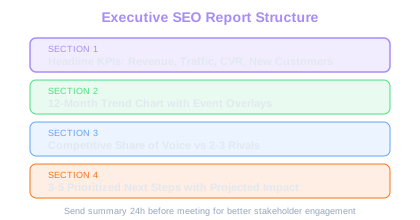
Send the executive summary 24 hours before any meeting. Stakeholders who have time to digest the top-line numbers will ask better questions and engage more productively with your detailed findings during the actual meeting.
Essential Ecommerce SEO Metrics to Report
Organic revenue is the single most important metric for ecommerce SEO reporting. Pull this from GA4 using a properly configured organic traffic segment with data-driven attribution. Report it as a total, as a percentage of overall revenue, and with year-over-year growth rate. These three views give stakeholders volume, share, and trajectory.
Organic conversion rate shows traffic quality. If organic traffic is growing but conversion rate is falling, you may be attracting the wrong visitors or your landing pages need optimization. Report this metric alongside overall site conversion rate so stakeholders can see how organic traffic quality compares to other channels.
Non-branded organic traffic isolates true SEO growth from brand-driven searches. A 30% increase in organic traffic means little if 25% of that increase comes from branded queries driven by a new TV campaign. Non-branded organic traffic growth is the purest signal that your SEO program is expanding the store's reach to new potential customers.
Product page indexation rate shows what percentage of your product catalog Google has indexed and is serving in search results. For large ecommerce stores with thousands of SKUs, getting every product page indexed is a fundamental challenge. Report the ratio of indexed product pages to total active product pages and track it monthly.
Average order value from organic traffic compared to other channels reveals whether SEO is driving high-value or low-value purchases. Many ecommerce stores find that organic visitors have a higher AOV because they arrive with stronger purchase intent from specific product searches.
Non-Branded Signal
A 30% increase in organic traffic means little if 25% of that increase is branded queries from a TV campaign. Non-branded organic traffic growth is the purest signal that your SEO program is expanding reach to new customers.
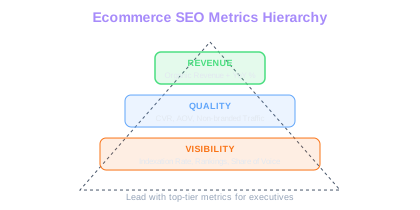
Visualizing SEO Data for Maximum Impact
Data visualization separates effective reports from forgettable ones. The human brain processes visual information 60,000 times faster than text, so how you present data matters as much as what data you present. For ecommerce SEO reporting, choose chart types that emphasize trends, proportions, and comparisons.
Use line charts for any metric tracked over time, including organic revenue, traffic, and conversion rates. Always show at least twelve months of data and add a trendline. Overlaying two related metrics on the same chart, such as organic traffic and organic conversion rate, can reveal whether traffic growth is coming at the expense of quality.
Use stacked bar charts to show organic revenue contribution by product category. This visualization instantly communicates which categories drive the most organic revenue and how that mix is changing over time. A CMO can look at a stacked bar chart and immediately see that the electronics category is growing while apparel organic revenue is declining.
Pie charts work for showing channel mix at a single point in time, such as organic search's share of total traffic or revenue compared to paid, direct, email, and social. However, never use pie charts for comparisons across time periods. Use grouped bar charts instead so the changes in each channel's contribution are visually clear.
Scatter plots are excellent for showing the relationship between SEO investment and results at the page or category level. Plot each product category with optimization hours on the X-axis and organic revenue change on the Y-axis. Categories in the upper-right quadrant received investment and delivered returns. Categories in the lower-right received investment but underperformed, which warrants investigation.
Use consistent colors across all reports. Assign organic search a single color, such as green, and use it in every chart and every report. Over time, stakeholders will instantly associate that color with organic performance without reading the legend.
Reporting Cadence and Automation
Monthly reports are the standard cadence for ecommerce SEO. Weekly reporting creates noise because organic search changes gradually, and daily fluctuations in rankings and traffic are not actionable at the strategic level. Quarterly reports work for executive summaries and strategic reviews but are too infrequent for operational teams that need to spot problems early.
Automate as much of the data collection as possible. Use Looker Studio (formerly Google Data Studio) to build live dashboards that pull from GA4, Google Search Console, and third-party SEO tools via API connectors. Once built, these dashboards update automatically, freeing you from the manual work of pulling data into spreadsheets every month.
However, do not rely on automated dashboards alone. The most valuable part of an SEO report is the analysis and interpretation that a human provides. A dashboard can show that organic traffic dropped 15% last month, but only an analyst can explain that the drop was caused by a Google algorithm update that affected category page rankings, and recommend specific content improvements to recover.
Create a reporting template that includes both automated data sections and manual analysis sections. The data sections pull directly from your dashboards. The analysis sections contain your interpretation of what happened, why it matters, and what actions should follow. Save this template and reuse it monthly so stakeholders receive a consistent format they learn to read efficiently.
Set up automated alerts for significant changes. Configure GA4 custom insights to notify you when organic traffic drops or spikes beyond a threshold you define. These early-warning signals let you investigate and prepare stakeholder communication before anyone else notices the change and asks questions.
Handling Negative Results and Setting Expectations
Every SEO program will experience periods of decline. Algorithm updates, increased competition, seasonal patterns, and technical issues can all cause organic traffic and revenue to drop. How you report these declines determines whether stakeholders maintain confidence in your SEO program or start questioning its value.
Never hide negative results. Stakeholders who discover bad news on their own lose trust in the reporting process. Instead, lead with the bad news, explain the cause, and present your response plan. A report that says organic revenue declined 8% due to Google's March core update, then outlines the five specific content improvements underway to recover, demonstrates competence rather than failure.
Set expectations proactively by educating stakeholders about the nature of organic search, drawing on your ecommerce SEO strategy fundamentals. SEO is not a linear growth channel. Results compound over time but are subject to periodic disruptions from algorithm changes. Include a brief section in your initial reporting setup that explains the typical SEO investment timeline: technical foundation work in months one through three, content and authority building in months three through six, and measurable revenue impact from month six onward.
Provide competitive context when reporting declines. If your organic traffic dropped 10% but your three closest competitors dropped 15-20%, your relative position actually improved. Share-of-voice data makes this competitive framing possible and helps stakeholders understand that a decline can still represent a competitive win.
Finally, maintain a log of all SEO actions taken, algorithm updates observed, and business changes like product launches or site migrations. This historical record is invaluable when stakeholders ask why performance changed during a specific period. Without it, you are left speculating rather than providing data-backed explanations.
Create a simple timeline document that logs every algorithm update, every major SEO change you implement, and every significant business event. When a stakeholder asks why traffic changed six months ago, this log lets you answer with precision instead of guesswork.
Free Tools & Resources
Try our free SEO tools
Work Together With SEO Experts who understand ecommerce
World’s first Ecom-founded SEO agency