Analytics & Reporting
11 min readSEO Forecasting for Ecommerce
SEO forecasting transforms organic search from a vague growth initiative into a quantifiable business channel with predictable outcomes. By modeling the relationship between rankings, traffic, and revenue, you can project the expected return of SEO investments before committing budget. Accurate forecasts earn stakeholder trust, justify resource allocation, and set realistic expectations for organic growth timelines.
In this guide
Fundamentals of SEO Forecasting
SEO forecasting uses historical data, competitive intelligence, and market trends to project future organic performance. Unlike paid search forecasting, where you can predict outcomes from spend levels with reasonable accuracy, organic search forecasting involves more variables and wider confidence intervals. Accepting this uncertainty while still providing useful projections is the key skill.
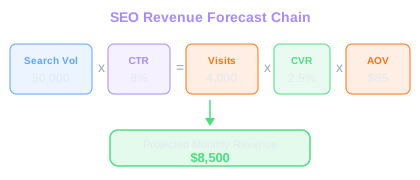
The basic forecasting model for ecommerce follows a chain of estimates. Start with the target keywords and their monthly search volumes. Apply expected click-through rates based on the ranking positions you aim to achieve. Multiply by your historical organic conversion rate, then by your average order value. The result is projected monthly organic revenue from those keywords.
For example, if a keyword group has 50,000 monthly searches, and you project reaching position 3 with an estimated 8% CTR, that yields 4,000 monthly visits. If your organic conversion rate is 2.5% and your average order value is $85, the projected monthly revenue from that keyword group is $8,500. Scale this across your full keyword opportunity set, and you have a top-down revenue forecast.
Always present forecasts as ranges rather than single numbers. A realistic forecast might say you expect organic revenue to increase by $40,000 to $65,000 per month within 12 months of executing the proposed SEO strategy. The range acknowledges uncertainty while still providing actionable guidance for budget decisions and calculating SEO ROI. The wider your range, the more honest your forecast, but if the range is too wide, it becomes useless for planning.
Range Over Precision
Always present forecasts as ranges. Projecting $40K-$65K monthly organic revenue gain within 12 months is more credible and useful than a single number that implies false precision.
Building a Click-Through Rate Model
Click-through rate by ranking position is the most critical variable in SEO forecasting. Small changes in CTR assumptions create large differences in projected traffic. Use your own Google Search Console data as the primary source for CTR modeling because CTR varies significantly by query type, device, and SERP feature presence.
Export your Search Console performance data for the past 12 months. Group queries by average position in whole-number buckets: position 1, position 2, position 3, and so on through position 20. Calculate the average CTR for each position bucket. You now have a custom CTR curve that reflects your specific brand, industry, and SERP environment.
Adjust your CTR model for SERP feature impact. Keywords where Google shows shopping ads, featured snippets, People Also Ask boxes, or image packs above organic results will have lower organic CTR than clean SERPs. For product-related queries, shopping ads typically reduce organic position one CTR from around 30% to 15-20%. If your target keywords trigger shopping ads, apply this discount to your forecast.
Account for branded versus non-branded differences. Your brand name queries will have CTRs two to three times higher than non-branded queries at the same position because searchers specifically looking for your brand are far more likely to click. Forecast branded and non-branded traffic separately, then combine them for a total projection.
Mobile versus desktop CTR also differs significantly. Mobile CTR tends to be lower for the same position because mobile SERPs are more cluttered with ads and features above organic results. If your store has a high mobile traffic share, weight your CTR model accordingly.
Rebuild your CTR model every six months. Google continuously tests new SERP layouts and features that shift organic CTR patterns. A CTR model based on two-year-old data will significantly overestimate or underestimate traffic depending on how SERP features have changed in your niche.
Keyword Opportunity Analysis
Accurate forecasting requires a thorough inventory of keyword opportunities. This means identifying not only the keywords you currently rank for but also the keywords you could realistically target with additional optimization or new content. The gap between current performance and total addressable opportunity defines your forecasting ceiling.
Start with your existing keyword portfolio from Search Console and your rank tracking tool. Categorize keywords by current ranking position and page type: product pages, category pages, blog posts, and informational content. For each group, identify how many keywords are in striking distance of page one, which typically means positions 11 through 20. These near-page-one keywords represent the fastest traffic gains because moving from position 15 to position 8 requires less effort than moving from position 50.
Next, conduct a competitive keyword gap analysis. Use tools like Ahrefs or Semrush to find keywords where your competitors rank but you do not. Filter this list to keywords with commercial or transactional intent that are relevant to your product catalog. This gap analysis reveals untapped opportunities that require new content or new product pages.
Estimate the effort required for each keyword group. Keywords where you already have a relevant page that just needs optimization require less investment than keywords requiring entirely new content creation. Assign each opportunity a difficulty score based on current ranking gap, competitor strength, and content requirements. This effort estimate is essential for connecting your forecast to a realistic budget and timeline.
Finally, prioritize keyword opportunities by projected revenue impact. A keyword group with 500 monthly searches and a $200 average order value is worth more than a group with 5,000 searches and a $5 AOV. Forecast revenue potential rather than traffic potential to ensure your priorities align with business goals.
Seasonal Forecasting for Ecommerce
Ecommerce businesses are inherently seasonal, and SEO forecasts that ignore seasonality will be wildly inaccurate. Most product categories see significant demand fluctuations throughout the year, from holiday shopping spikes to summer slowdowns. Your forecast must model these patterns to produce monthly projections that stakeholders can trust.
Build a seasonality index using at least two years of historical organic traffic data. For each month, calculate its traffic as a percentage of the annual average. If December typically gets 160% of average monthly traffic and February gets 75%, those indices become multipliers in your forecast. Apply these seasonal multipliers to your monthly baseline projections.
Google Trends data provides additional seasonal insight, especially for new product categories where you lack historical data. Combining this with seasonal keyword trends analysis sharpens your projections considerably. Search for your primary keyword categories in Google Trends and analyze the monthly interest patterns over the past five years. The relative interest peaks and valleys map directly to seasonal demand patterns you should incorporate into your forecast.
Account for seasonal content opportunities separately from evergreen product page traffic. Holiday gift guides, seasonal buying guides, and event-related content create temporary traffic spikes that should be modeled as distinct initiatives with defined start and end dates. A well-executed holiday content strategy might generate 50% of its total annual traffic in just two months.
Be explicit about seasonal risks in your forecast. If a competitor typically launches aggressive paid campaigns during your peak season, that may suppress your organic CTR during those months. If Google tends to run SERP layout experiments during certain periods, note that uncertainty. Stakeholders appreciate forecasts that account for both upside opportunity and downside risk.
Publish Early
Holiday content published in August reaches page one by November peak season. The same guide published in November misses 80% of the opportunity because SEO content needs 3-4 months to build ranking strength.
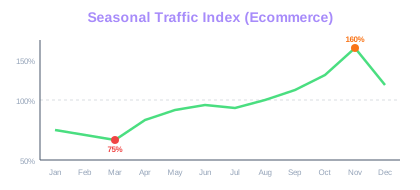
Start publishing seasonal content three to four months before the demand peak. SEO content needs time to get indexed, accumulate backlinks, and build ranking strength. A holiday gift guide published in November will miss most of the opportunity. The same guide published in August has time to reach page one by peak shopping season.
Forecasting Models and Tools
Several forecasting approaches work for ecommerce SEO, each with different complexity levels and accuracy trade-offs. Choose the method that matches your data availability, analytical capability, and the precision your stakeholders require.
The simplest approach is trend-based forecasting. Take your organic traffic and revenue trend over the past 12-24 months, calculate the average monthly growth rate, and project that rate forward. If organic revenue grew 4% month-over-month on average last year, project 4% monthly growth for the coming year. This works well when your SEO program is stable and no major changes are planned. It fails when you are planning significant new initiatives or when market conditions are shifting.
Scenario-based forecasting models three to four outcomes: pessimistic, baseline, optimistic, and sometimes a no-investment scenario. Each scenario uses different assumptions about ranking improvements, CTR, and conversion rates. The pessimistic scenario might assume only 50% of target keywords reach page one, while the optimistic scenario assumes 80%. This approach is excellent for budget discussions because it shows the range of outcomes tied to different investment levels.
Bottom-up forecasting builds from individual keyword projections. For each target keyword or keyword group, estimate the expected ranking, apply CTR and conversion rate, and sum up the projected revenue. This is the most granular and defensible approach but requires the most data and effort. It is ideal for specific initiative planning where you need to project the return of a defined set of SEO actions.
Advanced practitioners use regression models that correlate historical SEO activities with outcomes. By analyzing how past content production, link building, and technical improvements correlated with traffic and revenue changes, you can build a predictive model. Tools like Python with scikit-learn or even advanced Excel regression can power these models. The accuracy depends heavily on the quality and quantity of your historical data.
Communicating Forecasts and Managing Expectations
The way you present an SEO forecast determines whether it builds confidence or creates problems. A forecast that is too aggressive sets you up for failure when results inevitably fall short. A forecast that is too conservative may not justify the budget you need. Striking the right balance requires careful communication and ongoing calibration.
Always include your assumptions explicitly. State the CTR model you used, the conversion rate assumptions, the average order value, and the timeline for ranking improvements. When assumptions are transparent, stakeholders can challenge specific inputs rather than questioning the entire forecast. If a stakeholder says your CTR assumptions are too aggressive, you can adjust that single variable and show the updated projection immediately.
Present the forecast timeline in phases. Phase one, covering months one through three, should show primarily the impact of technical fixes and quick-win optimizations. Phase two, months four through six, shows the impact of content investments beginning to rank. Phase three, months seven through twelve, shows the compounding effect of sustained SEO investment. This phased approach manages the common expectation that SEO delivers results immediately and aligns with your broader ecommerce SEO strategy.
Compare your forecast against a no-investment baseline. Show what organic performance would likely look like if the company did not invest in SEO at all. In competitive markets, organic traffic does not stay flat without investment; it declines as competitors improve their positions. This comparison reframes the SEO investment as both an offensive growth play and a defensive necessity.
Review forecast accuracy quarterly. Compare your projections against actual results, document the variance, and explain the factors that caused any deviation. Over-forecasting is common in the early quarters. Use these reviews to refine your model inputs. After three or four quarterly calibrations, your forecasts will become significantly more accurate, and your credibility with stakeholders will be well established.
Keep a forecast accuracy scorecard that tracks predicted versus actual performance for each quarter. Over time, this scorecard becomes your most powerful credibility tool. When you can show that your past four quarterly forecasts were within 10-15% of actual results, stakeholders will trust your future projections without extensive debate.
Free Tools & Resources
Try our free SEO tools
Work Together With SEO Experts who understand ecommerce
World’s first Ecom-founded SEO agency