Search Fundamentals
10 min readEcommerce Ranking Factors
Once Google indexes your pages, a separate system decides where they rank. Google uses hundreds of signals to determine rankings, but not all of them carry equal weight for ecommerce. Knowing which factors move the needle for product and category pages lets you focus effort where it matters.
In this guide
- 1. How Google Ranks Ecommerce Pages
- 2. Page Experience and Core Web Vitals
- 3. Relevance Signals: Content and Keywords
- 4. Authority Signals: Backlinks and Domain Strength
- 5. E-E-A-T for Ecommerce
- 6. Putting It All Together: Prioritizing Ranking Factors
- 7. What the 2024 Google Content Warehouse Leak Revealed About Ranking
How Google Ranks Ecommerce Pages
Google's ranking system evaluates pages against each other for every search query. When someone searches for "wireless noise cancelling headphones", Google compares all indexed pages that could satisfy that query and ranks them based on relevance, authority, and user experience.
For ecommerce specifically, rankings are shaped by a mix of on-page content signals, technical performance metrics, backlink profiles, and user behavior patterns. A category page with detailed product descriptions, fast load times, strong backlinks from tech review sites, and high click-through rates from search results will consistently outrank a thin page on a domain with no external authority.
What makes ecommerce ranking different from informational content is the commercial intent behind most queries. Google knows that someone searching for product terms wants to buy, so it favors pages that facilitate purchasing. Pages with pricing, availability, reviews, and clear purchase paths tend to rank better than purely informational content for transactional queries.
Page Experience and Core Web Vitals
Core Web Vitals measure how users experience your pages. Google tracks three primary metrics: Largest Contentful Paint (LCP) measures how quickly the main content loads, Interaction to Next Paint (INP) measures how responsive the page is to user interactions, and Cumulative Layout Shift (CLS) measures visual stability as the page loads.
For ecommerce, these metrics directly affect both rankings and conversions. A product page that takes 4 seconds to show its main image (poor LCP) frustrates shoppers and signals to Google that the page delivers a subpar experience. A category page where product grids shift around as images load (poor CLS) leads to accidental clicks and higher bounce rates.
We have measured the impact of Core Web Vitals improvements on ecommerce sites. One electronics retailer improved their LCP from 4.2 seconds to 1.8 seconds by implementing lazy loading, compressing images, and upgrading their hosting. Over the following 8 weeks, their organic traffic to category pages increased by 15%, and their average position improved by 2.3 spots.
Mobile performance matters more than desktop for most stores. Over 65% of ecommerce searches happen on phones, and Google uses mobile-first indexing. If your mobile Core Web Vitals are poor even though desktop scores are good, rankings will suffer. Our guide to site speed optimization covers the most effective fixes for ecommerce stores.
Real Result
An electronics retailer improved LCP from 4.2s to 1.8s through image compression, lazy loading, and a hosting upgrade. Result: 15% organic traffic increase and 2.3-position improvement in 8 weeks.
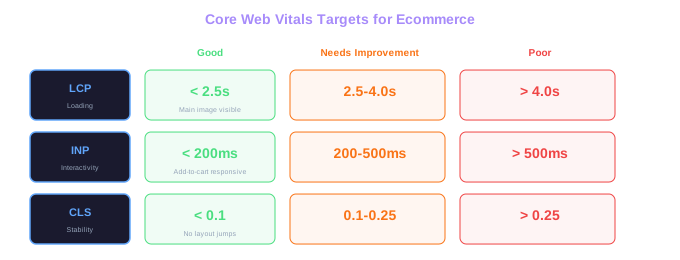
Check your Core Web Vitals in Google Search Console under Experience > Core Web Vitals. Focus on the mobile report first and fix URLs grouped as "Poor" before moving to "Needs Improvement".
Relevance Signals: Content and Keywords
Relevance determines whether Google considers your page a match for a given search query. For ecommerce, relevance signals include the page title, heading tags, product descriptions, category introductions, image alt text, and URL structure.
A category page targeting "men's running shoes" needs that phrase (and close variations) in its title tag, H1 heading, introductory text, and ideally in the URL path. But keyword usage has evolved far beyond simple repetition. Google's language models understand synonyms, related terms, and context. A well-written category description that naturally covers running shoe topics (cushioning, trail vs road, pronation support) sends stronger relevance signals than one that repeats "men's running shoes" ten times.
Product pages face a unique relevance challenge. The core commercial content (price, variants, add to cart) does not contain many words for Google to analyze. That is why surrounding content matters: unique product descriptions, specification tables, customer reviews, Q&A sections, and related product recommendations all add relevance signals that help Google understand what the page offers.
We consistently see product pages jump 5 to 15 positions in search results when we replace generic manufacturer descriptions with unique, detailed content that addresses common buyer questions.
Content Impact
Replacing generic manufacturer descriptions with unique, detailed content that addresses buyer questions typically moves product pages 5 to 15 positions higher in search results.
E-E-A-T for Ecommerce
E-E-A-T stands for Experience, Expertise, Authoritativeness, and Trustworthiness. While not a direct ranking factor measured by an algorithm, E-E-A-T shapes how Google's quality raters evaluate sites, which in turn influences ranking system updates.
For ecommerce stores, trust signals are the most impactful E-E-A-T component. Google wants to send users to stores where they feel safe making a purchase. Trust signals include visible contact information, clear return and refund policies, secure checkout (HTTPS), customer reviews, business registration details, and recognized payment providers.
Experience matters for stores that also publish content. If your outdoor gear shop publishes hiking trail reviews, Google values signals that the authors have actually used the products and hiked the trails. First-person product reviews with original photos, detailed field tests, and honest comparisons demonstrate real experience rather than surface-level content written by someone who has never touched the product.
Expertise shows through detailed product knowledge. Specification tables, compatibility guides, how-to content, and technical explanations all signal that your store understands its niche deeply. A camera store that publishes detailed lens comparison guides with sample images demonstrates expertise that a generic electronics retailer cannot match.
Authoritativeness grows over time through consistent quality, industry recognition, and mentions across the web. Stores that become known references in their niche, places where other sites naturally link and reference, build the kind of authority Google rewards with stable rankings.
Putting It All Together: Prioritizing Ranking Factors
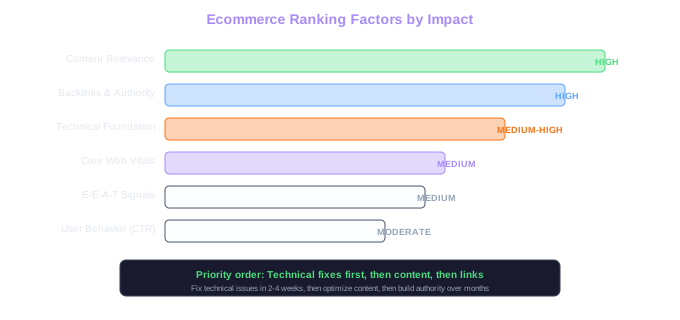
With so many ranking factors, knowing where to start can feel overwhelming. Based on working with hundreds of ecommerce sites, here is the priority order we recommend for most stores.
First, fix technical foundations. If Google cannot crawl, render, and index your pages properly, nothing else matters. Resolve crawl errors, fix broken canonical tags, ensure pages load within 2.5 seconds, and clean up your sitemap. This work typically takes 2 to 4 weeks and unblocks everything that follows.
Second, optimize on-page relevance for your highest-value pages. Start with your top 20 category pages by revenue potential. Ensure each has a unique title tag, a compelling meta description, an H1 that matches search intent, and at least 200 words of unique introductory content. Then move to your top 100 product pages.
Third, build authority through content and link acquisition. Create buying guides, comparison pages, and educational content that attracts backlinks. Pursue targeted outreach to industry publications and review sites. This is a continuous effort that compounds over time.
Fourth, monitor and improve user experience signals. Track Core Web Vitals monthly, analyze user behavior through heatmaps and session recordings, and optimize the mobile experience. Small improvements here drive both rankings and conversion rates.
The stores that succeed with SEO are not the ones that perfect one factor. They are the ones that maintain a reasonable standard across all factors while continuously improving their weakest areas. For a comprehensive overview of all these elements working together, see our ecommerce SEO pillar guide.
What the 2024 Google Content Warehouse Leak Revealed About Ranking
In May 2024, 14,014 attributes across 2,596 internal Google modules became public via the Content Warehouse API leak. The community indexes the disclosed signals at sites like seo-datawarehouse.com. For ecommerce stores, three findings reshape how rankings actually work.
First, ranking is a pipeline, not one algorithm. Google's stack chains microservices: Trawler crawls, Alexandria indexes, Mustang scores, then "twiddlers" rerank with NavBoost (click signals), freshness, diversity, and demotions. A page can score well in Mustang and still be demoted by a twiddler, or score poorly and get boosted because users love it.
Second, click data is real and weighted. NavBoost is referenced 84 times in the leaked docs and uses a rolling 13-month window of Chrome and Search clicks. Strong dwell on your result (lastLongestClick) lifts ranking; pogo-sticking back to the SERP demotes it. Title and meta copy that mislead users will earn clicks that produce badClicks and hurt rankings within months.
Third, sites face a CompressedQualitySignals "rap sheet" — siteAuthority, unauthoritativeScore, lowQuality flag, anchorMismatchDemotion, exactMatchDomainDemotion, and pandaDemotion all live here. This pre-filter decides whether a document gets passed to expensive ranking stages at all. If a store fails the rap sheet, no amount of on-page polish moves the needle.
Use the leak as a framework, not a recipe
The leak shows what Google can measure, not the exact weight of each signal. Use the disclosed signals to prioritise audits and explain to clients why a fix matters — but treat single-attribute optimisation with caution.
Free Tools & Resources
Try our free SEO tools
Work Together With SEO Experts who understand ecommerce
World’s first Ecom-founded SEO agency