Analytics & Reporting
12 min readCalculating SEO ROI
Proving the return on investment of SEO is one of the biggest challenges ecommerce marketers face. Unlike paid advertising where spend and revenue are directly linked, SEO investment and returns operate on different timelines and through indirect attribution paths. A rigorous ROI framework lets you justify SEO budgets, compare organic search against other channels, and make data-driven decisions about where to invest next.
In this guide
The SEO ROI Formula for Ecommerce
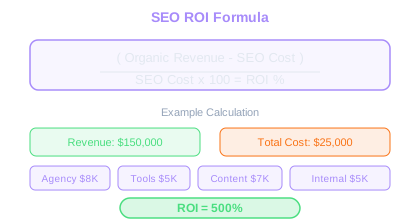
At its core, SEO ROI uses the same formula as any other investment: (Gain from Investment minus Cost of Investment) divided by Cost of Investment, multiplied by 100 to express it as a percentage. For ecommerce SEO, the gain is the revenue attributable to organic search, and the cost is everything you spend on SEO activities.
The challenge is accurately measuring both sides of this equation. On the gain side, you need to decide which attribution model to use. Last-click attribution credits revenue only to the final touchpoint before purchase. If a customer discovers your product through an organic search but returns through a paid ad to purchase, last-click gives SEO zero credit. Data-driven attribution in GA4 distributes credit more fairly across touchpoints but requires sufficient conversion volume to work reliably.
On the cost side, most companies undercount their true SEO investment. The obvious costs include SEO tools, agency fees, and content production. The less obvious costs include the portion of developer time spent on technical SEO, the internal team's salary allocation for SEO work, and the opportunity cost of choosing SEO over other marketing activities.
A realistic monthly ROI calculation might look like this: organic search generated $150,000 in attributed revenue with a total SEO investment of $25,000, including $8,000 in agency fees, $5,000 in tools, $7,000 in content production, and $5,000 in allocated internal team costs. The ROI is ($150,000 minus $25,000) divided by $25,000, times 100, which equals 500%. For every dollar invested in SEO, the store received five dollars in return.
Hidden Cost Trap
Developer time on technical SEO and internal salary allocations account for 30-40% of true SEO cost in most ecommerce companies. Omitting these inflates ROI by 2-3x and creates unrealistic expectations.
Track your SEO costs in a dedicated spreadsheet from day one. Most companies cannot calculate ROI accurately because they never tracked the cost side. Even rough estimates are better than nothing, but precise cost tracking makes your ROI calculations defensible when reporting to stakeholders.
Measuring the Revenue Side: Attribution Models
Choosing the right attribution model can change your SEO revenue figure by 20-40%, so this decision is not trivial. Each model tells a different story about organic search's contribution to revenue.
Last-click attribution is the simplest but consistently undervalues SEO. Organic search frequently operates as a discovery channel. Customers find your store through organic search, browse products, leave, and return later through a different channel to purchase. Under last-click, SEO gets no credit for initiating that journey. For ecommerce stores, last-click typically attributes 15-25% less revenue to organic search than data-driven models.
First-click attribution goes to the other extreme, giving all credit to the first touchpoint. This model overvalues SEO because it ignores the role of retargeting, email, and paid search in closing the sale. However, first-click does highlight organic search's role in new customer acquisition, which is a strategically important metric.
Data-driven attribution in GA4 uses machine learning to distribute credit based on the actual conversion probability each touchpoint adds. This model requires a minimum of 300 conversions and 3,000 ad interactions in 30 days to function, so smaller ecommerce stores may not have enough data. For stores that qualify, data-driven attribution provides the most balanced view.
Position-based attribution gives 40% credit to the first interaction, 40% to the last, and distributes the remaining 20% across middle touchpoints. This model works well for ecommerce stores that want to credit both discovery and closing channels. If organic search frequently appears as the first or last touchpoint, this model will reflect that importance.
For practical purposes, calculate SEO revenue under two or three models and present the range. Telling stakeholders that organic search drove between $120,000 and $165,000 in revenue depending on the attribution model is more honest and useful than picking a single number.
Calculating the Full Cost of SEO
Most ecommerce companies significantly underestimate their SEO costs, which inflates ROI calculations and creates unrealistic expectations. A complete cost accounting includes five categories: personnel, tools, content, technical implementation, and link building.
Personnel costs are usually the largest category. If you have an in-house SEO team, allocate their fully loaded cost, which includes salary, benefits, taxes, and overhead. If an employee spends 60% of their time on SEO, attribute 60% of their fully loaded cost. For agencies, this is straightforward: use the monthly retainer amount. Many companies use a blend of in-house and agency resources, so track both.
Tool costs include subscriptions for platforms like Ahrefs, Semrush, Screaming Frog, Surfer SEO, and any other SEO-specific tools. Do not forget to include the SEO-relevant portion of tools that serve multiple purposes. If your team uses Google Workspace, project management software, or analytics platforms partly for SEO work, allocate a fair portion of those costs.
Content production costs cover everything from strategy and writing to design, photography, and video production for SEO-driven content. Include freelance writer fees, editor time, stock photography purchases, and any design work for infographics or visual content that supports SEO goals.
Technical implementation costs are often overlooked. When your developers spend time implementing schema markup, fixing crawl errors, improving page speed, or building new SEO features, that time has a cost. Track developer hours allocated to SEO projects and multiply by their effective hourly rate.
Link building costs include outreach tools, digital PR agency fees, sponsorship costs for link-worthy mentions, and the time your team spends on link acquisition activities. If you purchase any form of links, despite Google's guidelines, those costs should also be tracked for accurate ROI calculations.
Create cost categories in your project management tool and tag all SEO-related tasks. At the end of each month, pull a report showing total hours by category. Multiply by the average loaded cost per hour for each team, and you have a precise cost figure without manual time tracking.
Incremental Revenue Analysis
Total organic revenue is useful, but incremental revenue analysis reveals the true impact of your SEO investment. Incremental revenue is the additional revenue your SEO efforts generated above what would have occurred without those efforts. This distinction matters because some organic traffic would arrive even without active SEO work.
Establish a baseline using historical performance data. Look at organic revenue trends over the 12 months before you started or increased your SEO investment. If organic revenue was growing at 5% year-over-year before your SEO program launched and is now growing at 25%, the incremental growth attributable to SEO is roughly 20 percentage points.
For a more rigorous approach, use a control group methodology. If you optimize product pages in one category but leave a comparable category untouched, the difference in organic revenue growth between the two categories estimates the incremental impact of your SEO work. This is not a perfect scientific control, but it provides much stronger evidence than before-and-after comparisons alone.
Another technique is to analyze the revenue contribution of specific SEO initiatives. If you launched a new series of buying guides and those pages now drive $30,000 in monthly organic revenue that did not exist before, that is clearly incremental revenue from SEO content investment. Track each major SEO initiative separately so you can attribute results to specific actions.
Be cautious about claiming all organic revenue growth as SEO-driven. Brand awareness campaigns, product launches, seasonal trends, and market growth all influence organic traffic independently of SEO efforts. The most credible ROI calculations acknowledge these external factors and focus on the portion of growth that can be reasonably attributed to SEO activities.
Customer Lifetime Value and SEO
Single-transaction ROI calculations dramatically undervalue SEO for ecommerce stores with repeat purchase behavior. If your average customer makes four purchases over two years, crediting SEO only with the first purchase's revenue ignores three-quarters of the customer's value. Incorporating customer lifetime value into your SEO ROI framework reveals the true long-term return.
Calculate the average lifetime value of customers acquired through organic search. Pull a cohort of customers whose first visit came from organic search, then track their total purchase value over 12 to 24 months. Compare this LTV to customers acquired through paid search, social media, and email. In many ecommerce businesses, organic search customers have a higher LTV because they found the store through genuine product research rather than being interrupted by an ad.
To incorporate LTV into ROI, multiply the number of new customers acquired through organic search by the average organic customer LTV. If SEO brought in 500 new customers this month and the average organic customer LTV is $340, the lifetime revenue impact is $170,000, not just the $45,000 those customers spent on their first purchases.
This approach shifts the ROI conversation from short-term transactional returns to long-term business value creation. A CEO who sees that SEO customers are worth 1.3 times more over their lifetime than paid search customers will view SEO as a strategic growth driver rather than just another marketing channel.
Track LTV by acquisition channel quarterly. As your data set grows, you will be able to project the future revenue value of each new organic customer, making your SEO forecasts and budget requests significantly more compelling.
Segment your LTV analysis by product category and customer type. You may find that organic search customers in specific categories have dramatically higher LTV than others, which should guide where you prioritize SEO investment for maximum long-term return.
Benchmarking SEO ROI Against Other Channels
SEO ROI means little in isolation. Stakeholders want to know how SEO compares to paid search, social advertising, email marketing, and affiliate programs. Building a cross-channel ROI comparison helps allocate marketing budgets based on which channels deliver the most efficient returns.
For a fair comparison, use the same attribution model, time period, and cost methodology across all channels. If you calculate SEO ROI using data-driven attribution and a six-month lookback window, apply those same parameters to Google Ads, Meta Ads, and every other channel. Switching models between channels produces misleading comparisons.
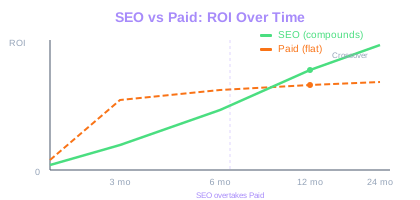
SEO typically shows a different ROI curve than paid channels. Paid search and social advertising generate immediate returns but have no residual value: when you stop spending, the traffic stops. SEO investment has a compounding effect. Content and technical improvements made today continue generating traffic and revenue for months or years without additional investment. This means SEO ROI tends to be lower in the first three to six months but significantly higher over twelve to twenty-four months.
Use blended efficiency metrics for apples-to-apples comparison. Cost per acquisition from organic search versus paid search is one of the most compelling metrics. If your cost to acquire an organic customer is $12 while paid search costs $45 per customer, the efficiency case for SEO investment is clear even before considering the higher LTV of organic customers.
Present the cross-channel comparison as a portfolio view. The strongest marketing strategy typically involves a mix of channels where each plays a different role. Paid search captures high-intent, immediate demand. SEO builds sustainable, low-cost traffic over time. Email and social nurture existing relationships. Showing how these channels complement each other makes a stronger case for continued SEO investment than positioning SEO as a competitor to other channels. For a comprehensive overview of how organic fits into your marketing mix, read our guide on ecommerce SEO.
CPA Benchmark
Ecommerce stores typically see organic customer acquisition cost of $8-15 versus $35-55 for paid search. Over a 24-month horizon, SEO ROI often exceeds paid search ROI by 3-5x due to compounding traffic gains.
Free Tools & Resources
Try our free SEO tools
Work Together With SEO Experts who understand ecommerce
World’s first Ecom-founded SEO agency