Link Building
8 min readGuest Posting for Ecommerce
Guest posting allows ecommerce brands to place expert content on established industry blogs and publications, earning high-quality backlinks while building authority in their niche. Unlike other link building tactics, guest posting gives you full control over the content, anchor text, and context surrounding your links, making it one of the most predictable and scalable strategies for improving organic rankings. Before diving into guest posting, review [backlink fundamentals for ecommerce](/academy/backlink-fundamentals-for-ecommerce) to understand what makes a link valuable.
In this guide
Finding Relevant Sites That Accept Guest Posts
The foundation of a successful guest posting strategy is a curated list of target publications that are genuinely relevant to your ecommerce niche. A link from a high-authority site in an unrelated industry carries far less weight than a link from a mid-authority blog that covers exactly your product category.
Start with Google search operators to discover opportunities. Queries like "your niche + write for us," "your niche + guest post guidelines," or "your niche + contribute" surface blogs actively seeking outside contributors. Expand your search by studying where your competitors have published guest content, tools like Ahrefs let you filter a competitor's backlinks by anchor text patterns commonly associated with author bios.
Evaluate each potential site on four criteria: domain authority (aim for DR 30+), topical relevance to your products, the quality of their existing content, and whether they provide dofollow links to contributors. Check several existing guest posts on the site to verify link policies before investing time in a pitch. Also review their social media engagement and comment sections, a site with genuine reader interaction will provide more value than a blog with high DR but zero audience engagement.
Check Before Pitching
Always verify dofollow link policies by inspecting 2-3 existing guest posts on each target site. Sites that strip links or add nofollow to all contributor links waste your outreach effort.
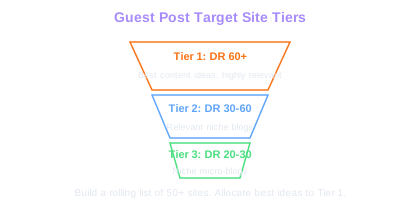
Build a rolling list of 50+ target sites and categorize them into tiers: Tier 1 (DR 60+, highly relevant), Tier 2 (DR 30-60, relevant), and Tier 3 (DR 20-30, niche blogs). Allocate your best content ideas to Tier 1 sites and use proven topics for lower tiers.
Pitching Topics That Get Accepted
Editors receive dozens of guest post pitches weekly, and most get rejected because they propose generic topics the site has already covered. A winning pitch demonstrates deep familiarity with the publication and offers a unique angle their readers have not seen.
Before pitching, spend 15-20 minutes studying the site's recent content. Identify topics they cover frequently, gaps in their editorial calendar, and the tone and style they prefer. Your pitch should reference a specific article on their site and explain how your proposed topic extends or complements that existing content.
Frame your pitch around a specific, actionable topic rather than a broad theme. Instead of proposing "Tips for Better Product Photography," pitch "How We Reduced Product Return Rates by 23% by Changing Our Photography Lighting Setup", the specificity signals expertise and gives the editor confidence the article will deliver genuine value. Include a brief outline with three to five subheadings to show the article is well-planned.
Keep your pitch email under 200 words. Open with who you are and why your expertise is relevant, state the topic and its unique angle in two sentences, provide the brief outline, and close with a simple question asking if they would be interested. Attach or link to two examples of your published work to establish credibility. For deeper outreach tactics, see our guide on email outreach for links.
Creating Value-Driven Content That Earns Links
A guest post that only exists to carry a backlink will be rejected by quality editors and ignored by readers. The content you contribute must stand on its own as genuinely useful, insightful, or entertaining, the backlink is a byproduct of delivering real value, not the purpose of the article.
Write for the host site's audience, not your own. Study their existing posts to match the depth, tone, format, and word count their readers expect. If the blog publishes 1,500-word tactical guides with screenshots, deliver exactly that. If they prefer opinion-driven essays with industry data, adapt accordingly. Mismatched content gets rejected regardless of quality.
Incorporate original data, case studies, or proprietary insights wherever possible. Generic advice available on any blog carries little editorial value. But a guest post that reveals your actual conversion rate improvements from a specific strategy, or shares primary research data you collected, becomes a genuinely valuable resource the editor is proud to publish.
Pay careful attention to internal linking within the host site. Linking to three to five relevant articles on the host blog shows the editor you understand their content ecosystem and increases the chance of your post being promoted through their internal linking structure. This also builds goodwill, making the editor more receptive to future pitches.
Write every guest post as if it were going on your own blog. The articles that earn the best links and drive the most referral traffic are the ones that genuinely help readers solve a problem, not thinly veiled promotional pieces.
Strategic Link Placement Within Guest Posts
Where and how you place links within your guest post significantly impacts their SEO value and their acceptance by editors. The days of keyword-stuffed anchor text in guest post bios are over, modern guest posting requires strategic, natural link placement that serves the reader.
Place your most important link contextually within the body of the article, not just in the author bio. A link that appears naturally within a relevant paragraph, supporting the point being made, carries more SEO weight and is less likely to be removed by the editor. Use descriptive but natural anchor text, "our guide to product page optimization" reads better than forced exact-match anchors.
Limit yourself to one or two links to your own site per guest post. Editors will reject articles stuffed with self-promotional links, and Google devalues pages with excessive outbound links to a single domain. If you have multiple pages to promote, spread them across different guest posts on different sites rather than cramming them into one article.
Consider which pages to link to carefully. Linking directly to product pages from guest posts often feels forced. Instead, link to high-value informational content on your site, buying guides, comparison articles, or research studies, that internally links to your commercial pages. This creates a natural link flow: guest post links to your informational content, which links to your product pages.
Natural Link Flow
Guest post links to your buying guide, which internally links to product pages. This two-step flow feels editorial to editors and passes authority to your commercial pages without appearing promotional.
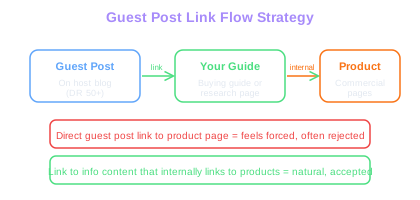
Create dedicated linkable assets on your site, comprehensive guides, original research, or free tools, specifically designed to receive guest post links. Our link building service can help identify the right assets to build. These assets convert link equity into rankings for your commercial pages through internal linking.
Measuring the ROI of Guest Posting
Guest posting is time-intensive, so measuring ROI is essential for knowing whether to scale up, adjust, or reallocate effort. Track both the direct SEO impact and the indirect brand benefits each guest post delivers.
For direct SEO measurement, monitor the referring domain count and domain rating growth that guest posts contribute. Use Ahrefs or Semrush to track new backlinks from each publication and note the corresponding movement in keyword rankings for the pages you linked to. A single guest post on a DR 60+ site often produces measurable ranking improvements within four to eight weeks.
Track referral traffic from each guest post using UTM parameters. Some guest posts drive significant direct traffic, a well-placed post on a popular industry blog can generate hundreds of qualified visitors. Compare this referral traffic's engagement metrics (time on site, pages per session, conversion rate) against your organic traffic to assess audience quality.
Calculate the full cost of each guest post including research time, writing time, editing, and outreach. Compare this cost to the alternative: buying equivalent links through sponsored content or digital PR. Most ecommerce brands find that the all-in cost of a quality guest post ranges from three to six hours of work, making it one of the most cost-effective link building tactics when compared to the value of a DR 50+ contextual backlink.
Avoiding Penalties and Maintaining Quality
Google has explicitly stated that large-scale guest posting for link building can trigger manual penalties. The key distinction is between guest posting that provides genuine editorial value and guest posting that exists solely to manipulate rankings. Understanding this line is essential for a sustainable strategy.
Avoid publishing on sites that are clearly guest post farms, sites that accept content on any topic from any author, publish multiple guest posts daily, and show no editorial standards. These sites are easy to identify by Google and links from them can trigger algorithmic devaluation or manual action.
Diversify your anchor text naturally. If every guest post links to your site with the exact same keyword-rich anchor text, the pattern is detectable. Use a mix of branded anchors, URL anchors, generic phrases, and natural variations of your target keyword. A healthy anchor text distribution looks organic, not manufactured.
Maintain genuine editorial relationships rather than one-time transactional exchanges. The best guest posting results come from becoming a regular contributor to three to five high-quality publications. Regular contributors earn better link placement, stronger editorial support, and increased trust, both from search engines and from the publication's audience.
Never pay for guest post placements on sites that offer "pay to publish" deals. These arrangements violate Google's link scheme guidelines, and the sites offering them are frequently identified and penalized. If a site charges a fee to publish your content, walk away regardless of their domain authority.
Audit your guest posting footprint every six months. Check that all your guest post links are still live, that the hosting sites maintain quality standards, and that your anchor text distribution looks natural when viewed as a whole portfolio.
Free Tools & Resources
Try our free SEO tools
Work Together With SEO Experts who understand ecommerce
World’s first Ecom-founded SEO agency