On-Page SEO
10 min readHomepage SEO for Ecommerce
Your homepage is the single most authoritative page on your entire domain. It receives the lion's share of backlinks, carries the most internal link equity, and sets the tone for how search engines understand your store. Yet many ecommerce sites waste this authority on flashy hero banners with zero text content, leaving Google guessing about what they actually sell. A strategically optimized homepage funnels authority to your most important categories and establishes your store as the topical authority in your niche. For a deep dive, read our [ecommerce homepage SEO](/blog/ecommerce-homepage-seo) guide.
In this guide
The Role of Your Homepage in Ecommerce SEO
Your homepage serves a fundamentally different SEO purpose than any other page on your site. While product and category pages target specific transactional keywords, the homepage targets your brand name and the broadest description of what your store offers. A shop selling outdoor gear should have a homepage that clearly communicates "we sell outdoor and camping equipment" to both humans and crawlers, not just a rotating carousel of sale items.
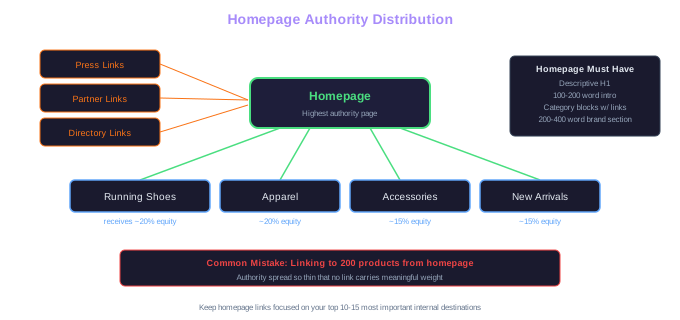
The homepage also acts as the primary distribution hub for link equity across your entire site through internal linking. External links from press coverage, partnerships, and directories almost always point to the homepage. Every internal link from the homepage passes a portion of that accumulated authority to the linked page. This makes your homepage navigation and linking structure one of the most consequential SEO decisions you'll make.
Brand searches often trigger the homepage as the top result, and Google uses the homepage to build its understanding of your site's overall topic. If Google can't figure out what you sell from your homepage, it will struggle to rank your deeper pages for relevant queries. Think of the homepage as your store's elevator pitch to search engines, clear, comprehensive, and well-organized.
Homepage Content Structure That Works
The ideal ecommerce homepage follows a content hierarchy that serves both SEO and conversion goals. Start with a clear H1 that includes your primary keyword phrase, something like "Premium Outdoor Gear & Camping Equipment" rather than a vague tagline like "Adventure Awaits." The H1 is one of the strongest on-page signals you can send, and wasting it on brand-only text misses an opportunity to rank for your core commercial terms.
Below the H1 and hero area, include a short introductory paragraph (100-200 words) that describes your store, what you sell, and why shoppers should buy from you. This paragraph gives Google the semantic context it needs to categorize your site. Mention your main product categories, your unique selling points, and any trust signals like years in business or number of satisfied customers.
Feature your top-level categories with both visual cards and text links. Each category block should include the category name as an H2 or H3, a brief description (2-3 sentences), and a link to the category page. This structure creates a clear topical hierarchy that tells Google your homepage is the parent of these category topics, and it gives you natural anchor text for your most important internal links.
End the homepage with a longer content section (200-400 words) that expands on your brand story, expertise, or unique value proposition. This bottom-of-page content doesn't interfere with the shopping experience because it sits below the product showcases. But it provides Google with substantial text to understand your site's focus and authority in the space.
Authority Math
Linking to 200 individual products from the homepage spreads authority so thin that no link carries meaningful weight. Link to 10-15 categories instead, letting category pages distribute authority to products below them.
Title Tag, Meta Description, and Schema
The homepage title tag is the one place where leading with your brand name makes sense, because most homepage searches are branded queries. The optimal formula is: Brand Name + Primary Keyword + Differentiator. For example, "TrailGear | Outdoor Gear & Camping Equipment | Free Shipping Over $50" hits the brand, the core keyword, and a conversion incentive in under 60 characters.
Your homepage meta description should serve as a mini-advertisement for your entire store. Include your main product categories, a trust signal, and a call to action. "Shop premium hiking, camping & climbing gear at TrailGear. 5,000+ products from top brands. Free returns & expert advice since 2012." This gives searchers multiple reasons to click while naturally incorporating category-level keywords.
Implement Organization schema on your homepage to tell Google about your business entity. Include your business name, logo, contact information, social media profiles, and founding date. This schema helps Google connect your brand with its Knowledge Graph and can trigger enhanced brand panels in search results. If you operate physical stores, add LocalBusiness schema with your addresses and hours.
Don't overlook the SiteNavigationElement schema for your main menu. While not a direct ranking factor, it helps search engines understand your site structure and can influence how sitelinks appear beneath your homepage in search results. Well-structured sitelinks make your listing take up more space in the results page, pushing competitors further down.
Common Homepage SEO Mistakes
The most frequent mistake we see is the "all images, no text" homepage. A full-screen hero banner, a grid of product images, and nothing else. Google can read alt text on images, but it's no substitute for actual paragraph content that establishes topical relevance. If your homepage has fewer than 200 words of visible text content, you're almost certainly underperforming in organic search.
Another common error is using the homepage H1 for a seasonal promotional message that changes every week. "Summer Sale - Up to 50% Off" tells Google nothing about what you sell. Your H1 should be stable and descriptive. Use banner overlays or separate promotional elements for time-sensitive messaging instead of hijacking your primary heading tag.
Slider carousels harm both SEO and conversion. Only the first slide's content gets full attention from users, and the rotating content creates a confusing signal for search engines that crawl the page at different moments. Replace sliders with a single, strong hero section that communicates your value proposition clearly. Studies consistently show that static hero images outperform sliders in conversion rate testing.
Finally, many stores make the mistake of stuffing their homepage with links to individual products instead of categories. Your homepage should link to categories (and maybe a handful of featured products), which then link to products. This aligns with a sound site architecture that keeps every page within a few clicks of the homepage. Linking to 200 individual products from the homepage spreads your authority so thin that none of those links carry meaningful weight. Keep the homepage focused on your top 10-15 most important internal destinations.
Slider vs Static Hero
Studies consistently show static hero images outperform carousel sliders in conversion rate testing. Sliders also create confusing SEO signals because Google crawls at different moments, seeing different first-slide content each time.
Free Tools & Resources
Try our free SEO tools
Work Together With SEO Experts who understand ecommerce
World’s first Ecom-founded SEO agency