Content & Authority
11 min readUser-Generated Content for SEO
Customer reviews, Q&A sections, community forums, and photo uploads create a steady stream of fresh, keyword-rich content that no editorial team could replicate at scale. User-generated content (UGC) helps ecommerce stores rank for long-tail queries, build trust signals, and increase page uniqueness, all without additional content production costs. This guide covers how to leverage UGC strategically while managing the SEO risks that come with unmoderated content.
In this guide
Why UGC Is an SEO Goldmine for Ecommerce
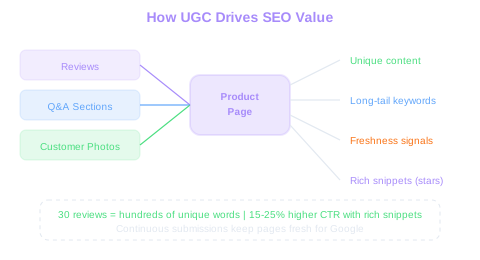
User-generated content adds unique text to pages that would otherwise be identical across retailers. If you and ten competitors sell the same blender, your product pages likely share the manufacturer's description word for word. Customer reviews differentiate your page with unique, natural language that Google values. A well-optimized product page with 30 reviews contains hundreds of additional words, many of which naturally include long-tail keyword variations that your copywriting team would never think to target.
Google's algorithms increasingly favor content that demonstrates genuine experience with a product. Reviews from verified buyers provide exactly this signal. The helpful content system rewards pages where users can find authentic first-hand perspectives. A product page with detailed reviews describing real-world usage scenarios outperforms a page with only marketing copy, regardless of how well-optimized that copy is.
Freshness is another major benefit. Customer reviews arrive continuously, providing Google with a steady stream of new content on pages that would otherwise remain static for months or years. Each new review triggers a content update signal that encourages Googlebot to recrawl the page. For product pages that rarely change, this ongoing freshness signal can be the difference between maintaining rankings and slowly losing ground to competitors who update more frequently.
UGC Scale Advantage
A product page with 30 reviews contains hundreds of unique words with natural long-tail variations no copywriter would target. Pages with review rich snippets see 15-25% higher click-through rates in search results.
Optimizing Product Reviews for Search Visibility
Product reviews become significantly more valuable for SEO when they are structured properly. Implement review schema markup (schema.org/Review and schema.org/AggregateRating) on every product page that has customer reviews. Our structured data for products guide covers the full implementation process. This enables rich snippets in search results, the star ratings and review counts that dramatically increase click-through rates. Pages with review rich snippets consistently see 15-25% higher CTR than pages without them.
Make reviews crawlable by rendering them in the page's HTML rather than loading them dynamically through JavaScript after page load. While Google can render JavaScript, server-side rendered reviews are indexed more reliably and quickly. If your ecommerce platform loads reviews via AJAX, work with your developer to implement server-side rendering for at least the first page of reviews.
Encourage detailed reviews by asking specific questions in your review form rather than providing only a blank text box. Prompt customers to describe how they use the product, what problem it solved, and how it compares to alternatives they considered. These structured prompts produce longer, more keyword-rich reviews that add significantly more SEO value than one-line ratings.
Display reviews prominently on the page and avoid hiding them behind tabs that require a click to reveal. Content behind tabs receives less weight from Google than content visible in the initial page load. Place the review section directly below the product description so both users and search engines encounter reviews as part of the natural page flow.
Send post-purchase review request emails 7-14 days after delivery, this gives customers enough time to use the product and write meaningful reviews. Include specific prompts like 'What was the main reason you chose this product?' to generate keyword-rich responses.
Q&A Sections as Long-Tail Keyword Engines
Question and answer sections on product pages capture search queries in their most natural form. When a customer asks "does this laptop bag fit a 15-inch MacBook Pro?", they are using the exact language that other shoppers type into Google. Over time, a well-populated Q&A section turns your product page into a long-tail keyword magnet that ranks for dozens of specific queries you never explicitly targeted.
Implement FAQ schema markup (schema.org/FAQPage) on product pages with Q&A sections to qualify for FAQ rich results in Google Search. These expanded search results display question-answer pairs directly in the SERP, occupying significantly more visual space than standard results. FAQ rich results can double your organic click-through rate for queries that trigger them.
Seed your Q&A section with the most common questions customers ask your support team. Pull data from support tickets, live chat logs, and customer emails to identify recurring product questions. Post these as pre-populated Q&A entries with thorough answers. This provides immediate SEO value while demonstrating to future customers that questions are welcome and answered promptly.
Allow customers to upvote helpful questions and answers to surface the most valuable content. This community moderation model ensures that the most relevant Q&A entries appear first, which improves user experience and ensures Google sees the highest-quality content at the top of the section. Implement a notification system that alerts your team when new questions are posted so answers arrive within 24 hours.
Customer Photos and Visual UGC
Customer-submitted photos add visual content that product photography cannot replicate. Professional product shots show the item in ideal conditions. Customer photos show it in real-world settings, in actual living rooms, on real body types, in genuine lighting conditions. This visual authenticity builds trust and keeps users on the page longer, which sends positive engagement signals to search engines.
Optimize customer photos for image search by adding descriptive alt text that combines the product name with the context visible in the photo. A customer photo of a red leather wallet sitting on a desk could have alt text like "customer photo of red leather bifold wallet on wooden desk." This level of specificity helps your product appear in Google Image searches for contextual queries.
Implement a photo gallery that loads customer images without slowing down the core page. Use lazy loading so customer photos only load as users scroll down to the gallery section. Compress uploaded images server-side to prevent customers' high-resolution phone photos from bloating your page load time. Core Web Vitals penalties from slow-loading UGC images can negate the SEO benefits of the content itself.
Create a moderation workflow for submitted photos. Review each image for quality, relevance, and appropriateness before publishing. Remove photos that are blurry, off-topic, or show the product alongside competitor branding. A curated gallery of genuine customer photos adds more SEO and conversion value than an unmoderated dump of every submitted image.
Add a photo upload option directly to your post-purchase review email. Customers are most likely to share photos when the product just arrived and they are excited. Make the upload process single-tap on mobile to maximize submission rates.
Managing SEO Risks of UGC
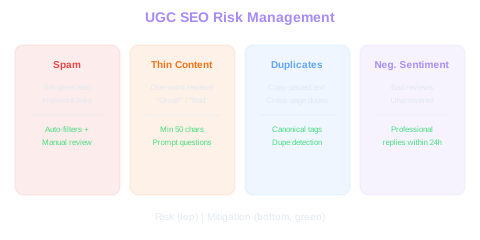
Unmoderated user-generated content introduces several SEO risks that must be actively managed. Spam is the most obvious threat, bots and bad actors can flood your review sections with irrelevant links, promotional content, or gibberish text. Implement automated spam filters that catch common patterns (excessive URLs, repeated text, off-topic keywords) and require manual moderation for reviews that trigger spam signals.
Thin content is a subtler risk. One-word reviews like "Great!" or "Bad" add almost no SEO value and can dilute the overall quality signal of your page. Set minimum character counts for reviews (aim for at least 50 characters) and encourage substantive feedback through your review prompts. Some platforms allow you to display only reviews that meet a quality threshold while still counting shorter ratings toward your aggregate score.
Duplicate content can arise when customers copy-paste manufacturer descriptions or when the same review appears on multiple pages. Implement canonical tags to handle pagination of review pages, and use duplicate detection to flag reviews that match content found elsewhere on your site or across the web.
Negative sentiment in reviews can affect perceived page quality. While you should never censor legitimate negative reviews, they build trust and credibility, you should respond to negative reviews with helpful, professional replies. This demonstrates active engagement and turns potential negatives into positive trust signals. Google's algorithms can analyze sentiment, and a page with thoughtful business responses to criticism signals a higher quality experience than a page with unanswered complaints.
Never Censor Reviews
Negative reviews build trust when paired with professional responses. A page with thoughtful replies to criticism signals higher quality to Google than a page with unanswered complaints or suspiciously perfect ratings.
Scaling UGC Collection Across Your Catalog
Most ecommerce stores have a review distribution problem: bestsellers accumulate hundreds of reviews while long-tail products have zero. This imbalance means your most competitive pages get the UGC boost they need least, while pages that could benefit most from unique content remain barren. A systematic UGC collection strategy addresses this imbalance.
Segment your post-purchase email campaigns by product review status. Products with fewer than five reviews should trigger more aggressive review request sequences, multiple follow-ups with incentives like loyalty points or discount codes for the next purchase. Products with 20 or more reviews can use a single-touch request. This weighted approach concentrates your collection efforts where they have the highest marginal impact.
Leverage social proof to encourage reviews on under-reviewed products. Display a message like "Be the first to review this product" with a visible incentive. Early reviewers are motivated by the desire to help others and the recognition of being first. Once two or three reviews are in place, the social proof effect takes over and subsequent reviews arrive more naturally.
Syndicate reviews across product variants and closely related products where appropriate. If a customer reviews a shirt in blue and you sell the same shirt in red, that review is relevant to both product pages. Review syndication fills gaps in your UGC coverage without creating duplicate content issues, provided you implement it with proper canonical handling and clear attribution to the original product.
Track your review coverage rate as a key metric: the percentage of active products with at least five reviews. Set quarterly targets to improve this metric and assign responsibility to your marketing or CX team. A store with 90% review coverage has a massive SEO advantage over a competitor with 30% coverage, even if total review volume is similar.
Create a review collection priority matrix: products with high search volume but few reviews get top priority. A product page ranking on page two with zero reviews might jump to page one simply by adding five detailed customer reviews that add unique, keyword-rich content to the page.
Free Tools & Resources
Try our free SEO tools
Work Together With SEO Experts who understand ecommerce
World’s first Ecom-founded SEO agency