Advanced SEO
12 min readSEO A/B Testing
Most ecommerce SEO decisions are made on intuition, best practices, or competitive mimicry rather than evidence. SEO A/B testing changes this by applying controlled experimentation to organic search optimization, allowing you to measure the actual impact of [title tag and meta description](/academy/title-tags-and-meta-descriptions) changes, structured data additions, and content modifications on clicks, impressions, and rankings before rolling changes out across your entire catalog.
In this guide
How SEO Split Testing Works
SEO A/B testing fundamentally differs from traditional conversion rate optimization (CRO) split testing. In CRO testing, you randomly split user traffic between two page variants and measure conversion differences. In SEO testing, you cannot show Google two different versions of the same URL. Instead, SEO split tests divide a group of similar pages into control and variant groups, apply changes only to the variant group, and measure the difference in organic search performance between the two groups.
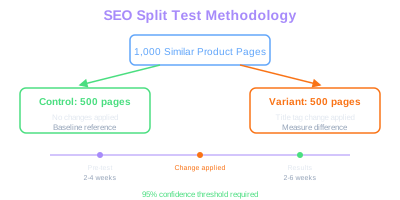
The methodology relies on the assumption that similar pages should experience similar organic traffic patterns over time. If you have 1,000 product pages in a category, you split them into two groups of 500. One group receives a title tag change while the other remains unchanged. After allowing sufficient time for Google to recrawl and re-index the changed pages, you compare the organic traffic trends of both groups. If the variant group shows statistically significant improvement relative to the control, the title tag change is validated.
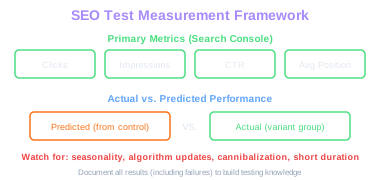
This approach is sometimes called 'time series split testing' because it compares the predicted performance of the variant group (based on its historical relationship with the control group) against its actual performance after the change. The control group accounts for external factors like seasonality, algorithm updates, and market trends that would otherwise confound your results.
The key requirement is having enough similar pages to create meaningful test groups. Ecommerce stores with large product catalogs are ideally suited for SEO testing because they naturally have thousands of similar product pages, category pages, or filtered landing pages that can be divided into test cohorts.
Sample Size Matters
You need at least 100 pages per group for reliable results, with 200-500 providing stronger statistical power. Ecommerce stores with large catalogs are ideally suited for SEO split testing.
Ensure your control and variant groups have similar historical performance patterns before starting a test. If one group has systematically higher traffic or different seasonality patterns, your test results will be unreliable. Use pre-test correlation analysis to validate group similarity.
Choosing What to Test on Ecommerce Pages
The most impactful SEO tests for ecommerce focus on elements that directly influence click-through rate from search results and on-page signals that affect rankings. Title tags are the highest-leverage element to test because they simultaneously affect both click-through rate and keyword relevance signals.
Title tag tests might compare formats like 'Product Name | Brand' versus 'Buy Product Name Online - Brand' versus 'Product Name - Free Shipping | Brand'. Each variation changes how the page appears in search results and which keywords it signals relevance for. On ecommerce product pages, including commercial modifiers like 'buy,' 'shop,' or 'free shipping' in titles often lifts click-through rate for transactional queries.
Meta descriptions do not directly impact rankings but significantly affect click-through rate. Test different value propositions: price emphasis, free shipping callouts, review ratings, unique selling points, or urgency signals. A meta description that increases CTR by 15% across 5,000 product pages translates to meaningful traffic gains without any ranking changes.
Heading structure and content organization tests examine how changes to H1 tags, subheading hierarchy, and content layout affect both rankings and engagement metrics. For product pages, test whether including key specifications in the H1 (like 'Nike Air Max 90 - Men's Running Shoe, Size 10') versus a cleaner H1 ('Nike Air Max 90') impacts organic visibility.
Structured data additions are excellent test candidates. Test whether adding FAQ schema, Review schema, HowTo schema, or enhanced Product schema attributes changes your appearance in search results and impacts click-through rates. Rich result eligibility can dramatically change the visual presentation of your listings.
Internal linking modifications test whether adding related product links, cross-category links, or contextual content links to product pages improves the organic performance of linked pages. These tests require longer durations because link equity effects take time to propagate.
Setting Up and Running SEO Tests
Proper test setup begins with page group selection. Identify a large pool of similar pages, typically within the same category or template type. The pages should share the same template structure, similar traffic levels, and comparable historical performance. Product pages within a single category or subcategory are ideal candidates because they share structural similarity and audience overlap. Optimizing category page SEO at scale becomes far more effective when guided by test data.
Randomly assign pages to control and variant groups. Random assignment is critical to prevent selection bias. Do not manually pick which pages go into which group, as this introduces bias that invalidates results. Use a random number generator or your testing tool's randomization feature. Aim for at least 100 pages per group, though 200-500 per group provides more reliable statistical power.
Before applying changes, run a pre-test period of 2-4 weeks where both groups remain unchanged. This validates that the two groups track each other closely and that your measurement methodology produces clean baselines. If the groups diverge significantly during the pre-test period, re-randomize or adjust your group composition.
Apply your change to the variant group and wait for Google to recrawl the modified pages. Monitor Google Search Console to confirm that Googlebot has recrawled and re-indexed the changed pages. The test duration depends on recrawl speed and the magnitude of the expected effect. Most SEO tests need 2-6 weeks of post-change data collection, with faster-crawled sites requiring less time.
During the test period, do not make any other changes to the test pages. No redesigns, content updates, redirect changes, or sitemap modifications for either group. Any concurrent change contaminates your results by introducing variables you are not testing.
Tag your variant pages in Google Search Console using a URL parameter or path pattern that lets you filter performance data specifically for the test group. This makes it easy to compare variant performance against the control without manual URL-by-URL analysis.
Measuring Results and Statistical Significance
Measuring SEO test results requires comparing the actual performance of the variant group against its predicted performance had no change been made. The prediction is derived from the control group's performance during the test period and the historical relationship between the two groups.
The primary metrics for ecommerce SEO tests are organic clicks, impressions, click-through rate, and average position from Google Search Console data. For revenue-focused tests, also track organic sessions and conversion data from your analytics platform. Be specific about which queries and pages you measure: filter for the exact pages in each group and the query types relevant to your test hypothesis.
Statistical significance determines whether the observed difference between control and variant groups is likely due to your change rather than random variation. Most SEO testing tools use Bayesian or frequentist statistical methods to calculate significance. A common threshold is 95% confidence, meaning there is less than a 5% probability that the observed difference occurred by chance.
Beware of common measurement pitfalls. Seasonality effects can create apparent improvements that are actually calendar-driven. Algorithm updates during your test period may benefit or harm one group disproportionately. Cannibalization between test and control pages can suppress results if the pages compete for the same queries. Short test durations increase the risk of false positives from temporary ranking fluctuations.
Document your results comprehensively regardless of outcome. Failed tests are as valuable as successful ones because they prevent you from rolling out changes that do not work. Build a testing knowledge base that records the hypothesis, methodology, duration, results, and confidence level for every test.
Failed Tests Matter
Failed tests prevent you from rolling out changes that do not work. Build a testing knowledge base recording hypothesis, methodology, duration, and confidence level for every experiment you run.
SEO Testing Tools for Ecommerce
Several specialized tools exist for SEO A/B testing, each with different approaches to test design, measurement, and analysis. Choosing the right tool depends on your technical capabilities, catalog size, and the types of changes you want to test.
SearchPilot (formerly DistilledODN) is the most established enterprise SEO testing platform. It operates as a reverse proxy that sits between your server and users, allowing it to modify page content for the variant group without changing your actual codebase. This makes it possible to test title tags, meta descriptions, content changes, and structured data modifications without developer involvement for each test. The proxy architecture means changes are visible to both users and Googlebot simultaneously.
SeoTesting.com takes a simpler approach by using Google Search Console data to measure the impact of changes you implement manually. You define your control and variant page groups, make changes to the variant pages through your normal CMS or development workflow, and the tool analyzes the performance difference. This requires more manual work but avoids the complexity and cost of a proxy solution.
Google's own tools can support basic SEO testing. Use Search Console Performance data filtered by page groups, combined with a statistical analysis tool like Google Sheets or Python scripts, to build a DIY testing framework. This approach requires more statistical expertise but costs nothing beyond your time.
For ecommerce platforms specifically, some tools integrate directly with popular platforms. Shopify, WooCommerce, and Magento all have ecosystem tools or plugins that facilitate bulk title tag and meta description changes needed for variant group modifications. The key is ensuring changes deploy cleanly to the variant group pages only, without affecting the control group.
Start with simple, low-risk tests like meta description changes before investing in enterprise testing tools. If meta description tests show measurable CTR improvements, that validates the testing methodology and justifies investment in more sophisticated tooling for title tag and content tests.
Building an SEO Testing Culture
The greatest value of SEO testing is not any single test result but the systematic elimination of guesswork from your optimization strategy. Building a testing culture means every proposed SEO change, from title tag formats to content templates to structured data implementations, gets validated through controlled experimentation before full deployment.
Create a prioritized testing roadmap that ranks potential tests by expected impact and implementation effort. High-impact, low-effort tests like title tag format changes should run first. Lower-priority tests like content length modifications or internal linking structure changes can follow once your testing infrastructure is proven.
Establish a testing cadence that keeps experiments running continuously. When one test concludes, the next should begin immediately. Aim for 12-20 SEO tests per year. Over time, the cumulative gains from validated optimizations compound: a 5% CTR improvement from title tags, plus a 3% ranking lift from structured data, plus a 7% traffic increase from content optimization, produces a combined effect far greater than any single change.
Share test results across your organization to build SEO credibility. When you can demonstrate that a proposed title tag format increased organic clicks by 12% with 97% statistical confidence, stakeholders trust SEO recommendations more than when changes are justified by blog posts or conference talks. Data-driven SEO advocacy secures resources and organizational support.
Use test results to create template-level standards. If testing proves that including price in product page title tags increases CTR, make that the default template for all future products. If adding FAQ schema to category pages increases impressions, deploy it systematically. Each validated test becomes a permanent improvement to your ecommerce SEO strategy.
Free Tools & Resources
Try our free SEO tools
Work Together With SEO Experts who understand ecommerce
World’s first Ecom-founded SEO agency