Industry Playbooks
13 min readElectronics & Tech SEO Playbook
Electronics and technology ecommerce is one of the most competitive verticals in organic search. You are competing against manufacturers with massive domain authority, marketplace giants, review publications, and price comparison engines, all for the same product keywords. Winning requires a strategy built around specification-driven search behavior, rapid product lifecycles, and the technical complexity that shoppers navigate when choosing electronics. This playbook covers the specific SEO techniques that drive organic growth for consumer electronics, computers, components, and gadget stores.
In this guide
Specification-Driven Keyword Architecture
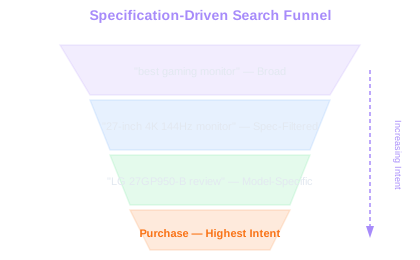
Electronics shoppers search with extraordinary specificity. Unlike fashion or food, where searches are often broad and exploratory, tech buyers frequently include model numbers, specifications, and technical parameters in their queries. "RTX 4070 Ti 12GB graphics card," "USB-C 100W GaN charger," "27-inch 4K IPS 144Hz monitor", these specification-rich queries represent buyers deep in the purchase funnel.
Build your keyword strategy around the technical specifications that define each product category. For monitors, the critical search dimensions are screen size, resolution, panel type, refresh rate, and connectivity. For laptops, they are processor, RAM, storage, display size, and GPU. Map these specification patterns to your category and product URL structures.
Create filterable category pages that generate indexable URLs for high-volume specification combinations. A URL like /monitors/4k/27-inch/ips should be indexable and contain unique content targeting shoppers looking for exactly that configuration. However, limit which filter combinations get indexed, only those with meaningful search volume. Block low-value permutations through robots.txt or noindex directives.
Include model numbers and part numbers in product page titles, H1 tags, and meta descriptions. Many electronics buyers search directly for model numbers: "Samsung QN65QN90C" or "Sony WH-1000XM5." If your product page title does not contain the exact model number, you will lose these high-intent searches to competitors who do.
Track new product announcement keywords. When a manufacturer announces a new GPU, processor, or phone model, search volume for that model spikes immediately. Having a product or pre-order page ready and indexed at announcement time captures traffic that would otherwise go entirely to news sites and review publications.
Spec Search Patterns
Electronics queries like "27-inch 4K IPS 144Hz monitor" contain 4-5 specification dimensions. Stores that create indexable URLs for the top 50-100 spec combinations per category capture traffic competitors miss entirely with generic category pages.
Product Page Optimization for Technical Products
Electronics product pages must serve both technically knowledgeable buyers who want raw specifications and less technical shoppers who need help understanding what those specifications mean. Structuring your pages to serve both audiences is essential for maximizing organic reach.
Create a comprehensive specifications table in crawlable HTML, not an embedded image or PDF. Include every relevant specification: dimensions, weight, processor, memory, storage, connectivity ports, battery life, display specs, compatibility, and included accessories. This specification table should use semantic HTML with clear labels so search engines can parse individual specs and potentially display them in rich results.
Write product page descriptions that translate specifications into real-world benefits. Do not just say "5000mAh battery", say "5000mAh battery delivers up to 14 hours of screen-on time for all-day use without charging." This approach captures both spec-driven searches and benefit-driven searches like "long battery life phone."
Implement Product schema markup with all relevant properties: name, brand, sku, gtin (UPC/EAN), mpn (manufacturer part number), description, image, offers, aggregateRating, and review. For electronics, the gtin and mpn fields are especially important because they connect your listings to Google Shopping and product knowledge panels.
Add comparison content directly on product pages. A section titled "How the XYZ Pro compares to the XYZ Standard" captures comparison query traffic, one of the highest-intent search patterns in electronics. Include a concise comparison table highlighting the key differences between common alternatives.
Display stock status, estimated delivery time, and warranty information prominently. Electronics purchases often involve significant spending, and shoppers compare these factors across retailers before buying. Pages that clearly communicate availability and purchase confidence tend to have lower bounce rates and higher conversion.
Check Google Search Console for queries containing "vs," "compare," "difference between," and "or" alongside your product names. These comparison queries are often high-volume and high-intent, and a dedicated comparison section on your product page or a standalone comparison page can capture them without creating new URLs.
Managing Rapid Product Lifecycles and Discontinuation
Electronics product lifecycles are measured in months, not years. New models launch constantly, and older products get discontinued while still receiving substantial search traffic. How you handle product turnover has a significant impact on your site's organic performance.
Never delete discontinued product pages that still receive traffic. When a product is no longer available, keep the page live but clearly mark it as discontinued. Add structured notices: "This product has been discontinued. See its replacement: [link to successor]." Redirect purchase intent to the successor model while preserving the ranking authority the old page has accumulated.
If a discontinued product has a direct replacement, consider adding a 301 redirect from the old URL to the new product page, but only if the replacement is genuinely equivalent. Redirecting a budget laptop page to a premium laptop page creates a poor user experience and sends confusing relevance signals to Google. When there is no direct equivalent, keep the old page live with recommendations for alternative products.
Maintain an archive or "previous generation" section for discontinued products. Many shoppers actively search for older models because they are looking for deals or replacement parts. Pages like /laptops/previous-generation can aggregate these products and continue capturing long-tail traffic.
Plan your URL structure to accommodate model refreshes. If your current URL is /laptops/brand-model-2025, you will need a new URL for the 2026 version. A better approach is /laptops/brand-model with content that updates as new versions release, preserving all accumulated ranking signals. If you must use year-specific URLs, establish proper canonical and redirect chains when new models launch.
Audit your site quarterly for orphaned discontinued product pages that have no internal links pointing to them. These pages still receive organic traffic from Google but are invisible within your site structure. Add internal links from relevant category and comparison pages to ensure these pages remain discoverable and pass authority back into your site.
Review and Comparison Content Strategy
Electronics shoppers are heavy researchers. The average consumer electronics purchase involves multiple touchpoints: reading reviews, watching comparison videos, consulting specification sheets, and comparing prices. Building a content layer around this research behavior captures traffic at every stage of the buyer journey.
Publish in-depth product reviews for your key products. These are not marketing descriptions, they are honest assessments covering strengths, weaknesses, ideal use cases, and how the product compares to alternatives. Google rewards genuine review content through its review system, and pages that demonstrate first-hand experience with the product receive ranking benefits.
Create head-to-head comparison pages for the most-searched product matchups in your category. "MacBook Air vs Dell XPS 13," "iPhone 16 vs Samsung Galaxy S25," "AirPods Pro 3 vs Sony WF-1000XM6", these comparison queries carry enormous search volume and land squarely within commercial intent. Structure comparison pages with side-by-side specification tables, category-by-category analysis, and clear verdict recommendations.
Build buying guide content for each major product category. "Best laptops for video editing 2026," "Best budget mechanical keyboards," "Best wireless earbuds for running", these guides target top-of-funnel queries and funnel readers toward your product catalog. Update guides at least quarterly to maintain freshness signals and reflect new product releases.
Incorporate customer reviews and user-generated content on product pages. Electronics shoppers heavily rely on peer reviews. Implement Review schema markup on customer reviews to earn review rich results in SERPs. Encourage detailed reviews that mention specific use cases, comparisons with competitors, and real-world performance metrics.
Technical SEO for Large Electronics Catalogs
Electronics stores often carry thousands of products across dozens of categories, each with multiple variants, accessories, and compatibility relationships. Managing crawl efficiency and site architecture at this scale requires deliberate technical SEO.
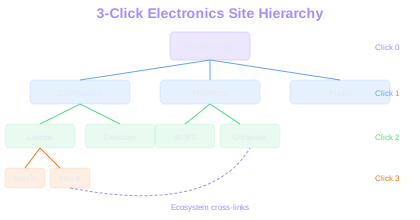
Implement a logical, shallow site architecture. Products should be reachable within three clicks from the homepage. Structure your hierarchy as: Department (Computers) > Category (Laptops) > Subcategory (Gaming Laptops) > Product. Each level should have a crawlable, internally linked page with unique content.
Handle product variants carefully. An electronics product might come in multiple storage configurations (128GB, 256GB, 512GB) or color options. If variants differ only in a minor attribute with no independent search volume, use a single canonical URL with on-page selectors. If a variant has meaningful search demand, "MacBook Pro 1TB" versus "MacBook Pro 512GB", give it a distinct URL with unique title and content.
Manage faceted navigation to prevent crawl bloat. Electronics category pages often have dozens of filters: brand, price range, screen size, processor type, RAM amount, storage type, connectivity. Allow Google to index the most valuable two-filter combinations while blocking deeper filter stacks. Use a combination of robots.txt disallow rules, canonical tags, and noindex directives based on search volume data.
Optimize page speed aggressively. Electronics product pages tend to be image-heavy (multiple product angles, lifestyle shots, specification graphics) and script-heavy (price comparison widgets, review carousels, 360-degree viewers). Lazy-load below-fold images, defer non-critical JavaScript, and serve images in modern formats (WebP, AVIF) to maintain Core Web Vitals compliance.
Build internal linking around product ecosystems. When a shopper views a laptop, link to compatible accessories (cases, chargers, docking stations), related products (similar specs, same brand), and complementary items (monitors, keyboards, mice). This ecosystem-based internal linking improves crawl discovery, distributes page authority, and increases average order value.
Variant URL Rule
If a variant has meaningful search demand (e.g., "MacBook Pro 1TB" vs "MacBook Pro 512GB"), give it a distinct URL with unique title and content. If it differs only in a minor attribute like color with no search volume, use a single canonical URL with on-page selectors.
Competitive Link Building for Electronics Retailers
Electronics link building requires a different approach than most retail verticals because the space is dominated by massive publications (CNET, The Verge, Tom's Hardware) and manufacturer sites. Competing for the same generic "best laptop" links is unrealistic for most retailers, but there are effective strategies specific to the electronics space.
Create original benchmark and testing data. If you can produce genuine performance benchmarks, battery life tests, display accuracy measurements, or thermal analyses, this data becomes a linkable asset that tech publications and forums reference. Even simple, well-documented tests like "We measured the actual battery life of 15 popular wireless earbuds" earn links from tech blogs, Reddit threads, and comparison articles.
Develop interactive tools that solve technical problems. A PC parts compatibility checker, a monitor size-to-desk calculator, a cable finder tool, or a schema generator gives users a reason to link to your site. These tools earn links organically from forums, tech communities, and buyer guide articles year after year.
Build relationships with tech YouTubers and bloggers who review products. Provide review units and early access to new products in exchange for honest reviews with links back to your product pages. Prioritize creators with established blogs or websites alongside their YouTube channels, as video platform links carry no SEO value while blog links do.
Contribute expertise to tech forums and communities. Answering technical questions on Reddit, Stack Exchange hardware communities, and specialized forums builds your brand reputation and can drive referral traffic and contextual links back to relevant product and guide pages on your site.
Publish authoritative guides on technical topics adjacent to your products: "How to choose a monitor for color-accurate photo editing," "Understanding Wi-Fi 7: what it means for your home network." These educational pieces target informational queries and earn editorial links from publications covering the same topics.
Monitor when major tech publications update their best-of lists and buying guides. Reach out to editors when your products deserve inclusion. A single link from a CNET or Wirecutter buying guide can drive substantial referral traffic and pass significant domain authority to your product pages.
Free Tools & Resources
Try our free SEO tools
Work Together With SEO Experts who understand ecommerce
World’s first Ecom-founded SEO agency