Advanced SEO
12 min readInternational Ecommerce SEO
Selling across borders introduces a layer of technical and strategic complexity that domestic SEO never touches. From hreflang implementation to currency-aware landing pages, [international ecommerce SEO](/blog/international-ecommerce-seo) requires precise configuration to ensure the right product pages appear for the right audiences in each market.
In this guide
Domain Structure: ccTLDs vs. Subdirectories vs. Subdomains
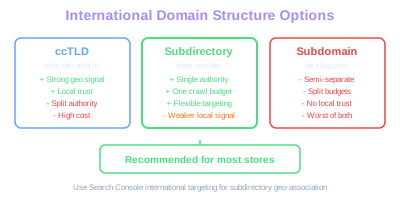
The choice between country-code top-level domains (ccTLDs like .de, .fr), subdirectories (/de/, /fr/), and subdomains (de.example.com) has lasting consequences for link equity distribution, crawl efficiency, and brand perception. Each approach comes with distinct tradeoffs that depend on your resources, market strategy, and existing domain authority.
ccTLDs provide the strongest geo-targeting signal and build local trust. German shoppers seeing a .de domain feel confident the store serves their market. However, each ccTLD starts with zero domain authority, requires separate Search Console properties, and splits your backlink profile across multiple domains. This approach demands significant investment in link building per market.
Subdirectories (example.com/de/) consolidate all link equity under a single domain, making them the preferred choice for most ecommerce operations. A single domain with strong authority lifts all regional subdirectories. Google can geo-target subdirectories through Search Console settings, and you maintain one crawl budget pool. The downside is weaker local trust signals compared to ccTLDs.
Subdomains (de.example.com) sit in an awkward middle ground. Google treats them as semi-separate entities, so link equity does not flow freely between subdomains. They require separate crawl budgets and often separate hosting, yet lack the local trust benefits of ccTLDs. Unless your CMS architecture forces subdomains, avoid this approach.
Authority Consolidation
A single domain with strong authority lifts all regional subdirectories. ccTLDs start with zero domain authority per market and require separate link building investment in each country.
Hreflang Implementation
Hreflang tags tell search engines which language and regional version of a page to serve for a given query. Without them, Google might show your English product page to French users, or worse, flag your regional variations as duplicate content and suppress them entirely. Proper canonical tag configuration works hand-in-hand with hreflang to prevent these issues.
The hreflang attribute uses ISO 639-1 language codes and optional ISO 3166-1 Alpha-2 country codes. A page targeting French speakers in Canada would use hreflang="fr-CA", while a page for French speakers in France uses hreflang="fr-FR". You must also include an x-default tag that points to your fallback page, typically the English version or a language-selector landing page.
Hreflang can be implemented via HTML link elements in the <head>, HTTP headers (necessary for PDFs and non-HTML resources), or XML sitemaps. For stores with thousands of products across multiple languages, XML sitemap implementation is the most maintainable approach. Each sitemap entry lists all language/region alternates for that URL, which avoids bloating your HTML head section.
The most common hreflang error is missing return tags. If page A references page B as its German alternate, page B must reference page A back. Asymmetric hreflang annotations are ignored by Google entirely. Use a validation tool like Aleyda Solis's hreflang tag generator or Screaming Frog's hreflang audit to catch these issues before they reach production.
Return Tag Rule
The most common hreflang error is missing return tags. Use XML sitemap implementation for stores with thousands of products across multiple languages to keep annotations maintainable.
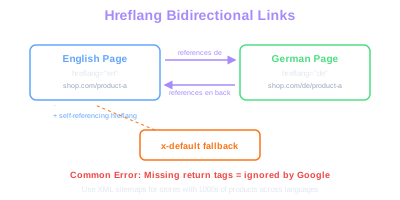
Always include a self-referencing hreflang tag on every page. The English page should declare itself as the en alternate. Missing self-references cause validation failures across the entire hreflang cluster.
Content Localization vs. Translation
Machine-translating your product pages and calling it localization is a shortcut that costs conversions and rankings. True localization means adapting product descriptions, sizing charts, payment references, shipping information, and cultural context for each target market.
Consider a US-based shoe store expanding to Germany. Direct translation of product descriptions misses that Germans use EU sizing, expect prices inclusive of VAT, prefer bank transfer (Uberweisung) alongside card payments, and expect delivery timeframes stated in Werktage (working days). Search behavior also differs: Germans might search for "Laufschuhe Damen" rather than a literal translation of "women's running shoes."
Keyword research must be repeated for each market. Do not assume translated keywords carry the same search volume or intent. The Spanish market might prefer different product category names than what a direct translation suggests. Use local keyword tools, analyze local competitor sites, and validate with native speakers who understand ecommerce terminology.
Reviews, user-generated content, and trust signals also need localization. Showing English-language reviews on a German store page undermines trust. Integrate local review platforms (Trustpilot for Europe, for example) and display reviews in the local language.
Currency, Pricing, and Structured Data
International stores must handle multi-currency pricing with precision, both for user experience and for structured data accuracy. Your Product schema markup must reflect the actual currency and price shown to the user on that specific regional page. Showing EUR prices on the page but declaring USD in your schema will trigger rich result penalties.
Use the priceCurrency field in your Product structured data with the correct ISO 4217 currency code for each regional page. If you offer dynamic currency conversion, the structured data should match the default displayed price, not a converted estimate. Google's rich results testing tool validates this per-page, so test regional variations separately.
Shipping cost structured data (shippingDetails in Product schema) must also be regionalized. Declaring free US shipping on a page targeting German customers is misleading and can result in merchant penalties in Google Shopping. Define shippingDestination with the correct country code and accurate delivery rates for each market.
Tax handling varies dramatically by country. US prices are typically shown pre-tax, while EU regulations require VAT-inclusive pricing. Make sure your structured data and displayed prices align with local legal requirements. Discrepancies between what Google reads in your markup and what users see on the page erode trust and can trigger manual actions.
Create a structured data template per region that automatically pulls the correct currency code, tax treatment, and shipping destination. This prevents copy-paste errors when rolling out products across markets.
International Technical Considerations
Server location and CDN configuration directly impact page speed for international visitors. A store hosted on a single US server will deliver slow load times to European and Asian shoppers. Use a CDN with edge nodes in your target markets, and configure it to serve region-specific content without redirect chains.
Avoid IP-based redirects that force users to a regional version without consent. Google crawls primarily from US IP addresses, so IP redirects can prevent Googlebot from discovering your non-US pages. Instead, use a banner or interstitial that suggests the regional version while allowing users (and bots) to access any version freely.
XML sitemaps should be structured to help search engines discover all regional variants efficiently. Create a sitemap index that references regional sub-sitemaps, each containing the hreflang annotations for that market's URLs. Submit each regional sitemap to the corresponding Search Console property.
Monitor international search performance separately per market. Set up Search Console properties for each country or subdirectory target, track keyword rankings with geo-specific rank tracking tools, and segment your analytics by region. A page ranking well in the US might be invisible in Germany due to hreflang errors, content gaps, or local competitor dominance.
Managing International Link Building
Link authority does not transfer evenly across international page variants. A backlink to your US product page does not boost your German version's rankings in google.de. Each regional market requires its own link building strategy, targeting local publications, industry directories, and regional influencers. Our international SEO services can help you build market-specific authority at scale.
Identify link prospects per market by analyzing competitor backlink profiles in each target country. A German competitor's backlink sources reveal which local blogs, magazines, and directories actively link to ecommerce stores in that vertical. Tools like Ahrefs and Semrush allow filtering by referring domain country.
Digital PR campaigns should be adapted per market, not just translated. A product launch story that resonates with US media might need a completely different angle for French journalists. Work with local PR agencies or freelancers who understand each market's media landscape and journalist expectations.
Internal linking across language versions should be strategic. Your English blog post about running shoe technology should link to the English product pages, while the German translation links to the German products. Cross-language internal links confuse the hreflang relationship and dilute topical relevance signals.
Free Tools & Resources
Try our free SEO tools
Work Together With SEO Experts who understand ecommerce
World’s first Ecom-founded SEO agency