Link Building
10 min readCompetitor Backlink Analysis
Your competitors have already done the hard work of finding sites willing to link to ecommerce content. Analyzing their backlink profiles reveals exactly which websites, journalists, and bloggers are open to linking in your niche, giving you a proven roadmap instead of guessing where to focus your outreach efforts. Before starting, make sure you understand the [backlink fundamentals for ecommerce](/academy/backlink-fundamentals-for-ecommerce) that determine which links are worth pursuing.
In this guide
Identifying Your True Link Competitors
Your link competitors are not always the same as your business competitors. A large retailer that sells the same products may dominate in revenue, but a smaller niche blog or specialist store may actually hold the backlink profile you need to study. Link competitors are the sites that rank for your target keywords and have strong backlink profiles driving those rankings.
To find your link competitors, start with your top 20 target keywords and note which domains consistently appear in positions one through five. The domains that show up repeatedly across multiple keywords are your primary link competitors. Tools like Ahrefs, Semrush, or Moz allow you to enter your domain and automatically surface competing domains based on keyword overlap.
Focus on competitors of similar size and business model first. Analyzing the backlink profile of Amazon or Walmart will yield mostly unactionable data, their links come from scale and brand recognition that a mid-market store cannot replicate. Instead, study the stores and content sites one or two steps ahead of you. Their link sources represent achievable targets for your own outreach.
Create a spreadsheet of five to eight true link competitors. Include their domain rating, total referring domains, and the number of keywords they rank for. Update this quarterly to track how your backlink profile compares and to spot new competitors entering your space.
Extracting and Organizing Competitor Backlinks
Once you have identified your link competitors, pull their full backlink profiles using Ahrefs, Semrush, or Majestic. Export the data into a spreadsheet and focus on the columns that matter most: referring domain, domain rating, anchor text, target URL, link type (dofollow or nofollow), and first seen date.
Sort the export by domain rating descending to surface the most authoritative links first. These high-authority links represent your highest-value targets. A link from a DR 70+ site that already links to a competitor is a strong candidate for your outreach list because the site has demonstrated willingness to link to ecommerce content in your niche.
Filter out low-quality links, domains with ratings below 20, foreign language sites irrelevant to your market, and obvious link farms or directories. This filtering typically removes 40-60% of a competitor's backlinks, leaving you with a curated list of genuine link opportunities. Group the remaining links by type: editorial mentions, product reviews, resource pages, guest posts, directories, and brand mentions.
Pay attention to the target URLs. If a competitor earned most of their links to a specific buying guide or data study, that tells you what type of content attracts links in your niche. If their links point primarily to their homepage, it suggests brand-level PR activity rather than content-driven link building.
Finding Link Gaps Between You and Competitors
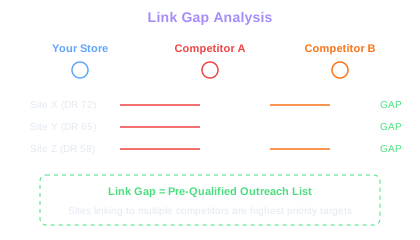
A link gap analysis reveals domains that link to your competitors but not to you. This is one of the most efficient ways to build a prospect list because these sites have already demonstrated interest in your product category.
In Ahrefs, the Link Intersect tool lets you enter your domain alongside up to ten competitors. The tool returns a list of domains that link to one or more competitors but not to your site. Semrush offers a similar feature called Backlink Gap. The resulting list is essentially a pre-qualified outreach list, every domain on it has linked to similar content before.
Prioritize link gap opportunities where a domain links to multiple competitors. If a site links to three of your five competitors, it has a strong pattern of covering your product category and is highly likely to consider linking to your content as well. These multi-competitor linking domains should sit at the top of your outreach queue.
Also look for gaps at the page level. If a competitor has a buying guide that earned 50 referring domains and you have no equivalent page, that gap represents both a content opportunity and a link building opportunity. Create a better version of that content, then reach out to the sites linking to the competitor's version.
Pre-Qualified Leads
Link gap domains have already proven they link to ecommerce content in your niche. Sites linking to 3+ competitors convert at the highest outreach rates because they actively cover your product category.
Analyzing Competitor Link Velocity and Trends
Understanding how quickly competitors acquire new links, and which content is currently earning them, reveals tactical opportunities. A competitor with steady link growth of 20-30 new referring domains per month is executing an active link building program you can learn from. A competitor whose link growth has flatlined presents an opportunity to overtake them.
Most backlink tools let you filter links by the date they were first discovered. Review the links your top competitors acquired in the last 90 days. This recent activity shows their current strategy, are they earning links through product launches, PR campaigns, content marketing, or guest posting? Understanding their active approach helps you anticipate their next moves and identify tactics worth adopting.
Track seasonal patterns in competitor link acquisition. Many ecommerce niches see link spikes around specific events: holiday gift guides in November, back-to-school roundups in August, or industry trade shows. By noting when competitors earn the most links, you can time your own content creation and outreach to coincide with these high-opportunity windows.
Compare link velocity across competitors to calibrate realistic goals. If the top three stores in your niche average 15 new referring domains per month, setting a target of 50 per month is unrealistic. Aim to match or slightly exceed the average growth rate of your direct competitors.
Set up weekly alerts in Ahrefs for your top three competitors. Every time they earn a new backlink from a DR 40+ domain, you will receive a notification. This lets you react quickly, if a competitor gets featured in a roundup article, you can pitch the same author before the article becomes stale.
Reverse-Engineering Competitor Link Building Tactics
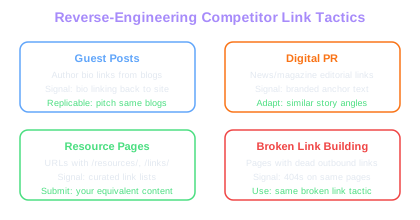
Studying the patterns in a competitor's backlink profile reveals their entire link building playbook. Look for clusters of links that share common characteristics, these clusters indicate specific tactics the competitor is using.
A cluster of links from blogs with author bios linking back to the competitor's site indicates an active guest posting strategy. Note the blogs accepting guest posts, the topics covered, and the quality standards. These same blogs are potential targets for your own guest posting outreach.
Multiple links from news sites and online magazines, especially with brand mentions in the anchor text, suggest a digital PR for ecommerce strategy. Examine what stories the competitor pitched to earn those links, product launches, original research, expert commentary, or charity partnerships. These PR angles can be adapted for your own brand. Our off-page SEO for ecommerce guide provides a complete framework for executing these strategies.
Links from resource pages (URLs containing terms like /resources/, /links/, /tools/) indicate the competitor has pursued resource page link building. Visit each resource page to understand what type of content gets listed and whether your site has equivalent content worth submitting.
Finally, check for patterns of broken link building. If a competitor has links from pages that also link to dead URLs in similar niches, they may have used broken link building to secure those placements. You can use the same technique on the same pages to earn additional links.
Turning Analysis into an Actionable Outreach Plan
Raw competitor backlink data is useless without a structured plan for acting on it. Convert your analysis into a prioritized outreach list with clear next steps for each prospect.
Create a master prospecting spreadsheet with columns for: domain, contact person, email address, link type (guest post, resource page, editorial mention), competitor they currently link to, their domain rating, and your outreach status. Populate this sheet from your link gap analysis and competitor backlink review. Most analyses yield 100-300 viable prospects from five competitor profiles.
Prioritize prospects using a scoring system. Assign points for domain authority (higher is better), relevance to your niche (exact match topics score highest), number of competitors they link to (more competitors linked means higher willingness), and the type of link opportunity (editorial mentions score higher than directory listings). Sort by total score and work from the top down.
Group prospects by outreach type. Resource page prospects need a different email than guest post prospects or journalists who cover your product category. Batch your outreach by type so you can personalize templates efficiently. A well-organized prospecting sheet transforms months of potential link building into a systematic workflow that can be executed week by week.
Track your success rate per competitor. If you successfully replicate 20% of one competitor's backlinks within six months, that represents significant ranking progress. Most ecommerce stores find that 10-15% replication rate is achievable with consistent outreach, which can translate to 30-50 new referring domains from a single competitor analysis.
Free Tools & Resources
Try our free SEO tools
Work Together With SEO Experts who understand ecommerce
World’s first Ecom-founded SEO agency