Content & Authority
10 min readContent Strategy for Stores
An ecommerce content strategy connects every blog post, guide, and resource page to a commercial outcome. Without a plan, stores produce scattered content that attracts visitors who never buy. With one, every piece of content serves a specific role in the customer journey and drives measurable revenue. Here is how to build a content strategy that treats content as a sales channel, not a vanity metric.
In this guide
Mapping Content to the Buying Journey
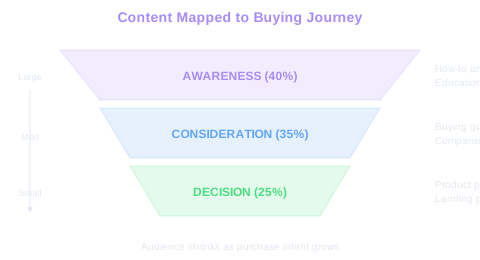
Every piece of content on an ecommerce site should map to a stage in the buying journey: awareness, consideration, or decision. Awareness content attracts people who do not yet know they need your product, they are searching for solutions to a problem. Consideration content helps shoppers compare options and evaluate features. Decision content removes the last objections and drives the purchase.
Most stores over-invest in decision-stage content (product pages, sales copy) and under-invest in awareness and consideration content. The result is a site that only captures shoppers who already know exactly what they want. That audience is small and fiercely competitive. The much larger pool of potential customers, those still researching, goes to competitors who publish helpful content earlier in the journey.
A balanced content strategy allocates roughly 40% of effort to awareness content (how-to articles, educational guides, problem-solving posts), 35% to consideration content (buying guides, comparisons, reviews), and 25% to decision content (product page optimization, landing pages, promotional content). These ratios shift depending on your market maturity and product complexity, but the principle holds: capture shoppers early and guide them toward a purchase.
Funnel Math
Stores that only publish decision-stage content compete for the smallest audience slice. The awareness and consideration stages represent 75% of total search demand in most ecommerce niches, yet fewer than 20% of stores publish content targeting these stages.
Building a Content Calendar Around Product Categories
A content calendar for an ecommerce store should revolve around product categories, not arbitrary topics. Start by listing your top revenue-generating categories and the seasonal peaks for each. A garden supply store knows that lawn care content must publish by February to rank before the spring rush. A ski equipment retailer needs gear guides live by September.
For each category, plan four content types per quarter: one long-form buying guide, one comparison article, two supporting blog posts that target long-tail questions. This creates a steady publishing cadence that builds topical authority without overwhelming your team. A store with 10 product categories would produce 40 pieces of content per quarter, roughly three per week.
Coordinate your content calendar with inventory and merchandising. If you are launching a new product line in March, the supporting content, buying guides, comparison articles, FAQ updates, should publish four to six weeks before the launch date. This gives Google time to index and rank the content so it drives traffic when the products go live.
Track your calendar in a simple spreadsheet or project management tool. Each entry should include the target keyword, content type, assigned writer, publish date, target category, and funnel stage. Review the calendar monthly to adjust priorities based on seasonal trends and performance data.
Timing Matters
Content published 4-6 weeks before a seasonal peak catches Google's indexing window. A ski gear guide published in November misses the ranking window entirely. Publish by early September to rank by peak demand in December.

Publish long-form guides and comparison articles 4-6 weeks before seasonal demand peaks. Google needs time to crawl, index, and rank new content, publishing too close to the peak means you miss the traffic window.
Content Formats That Drive Ecommerce Revenue
Not all content formats convert equally for ecommerce. Buying guides consistently generate the highest revenue per visitor because they capture shoppers at the moment of decision. Product comparison articles rank second, they target specific purchase dilemmas and funnel readers directly to product pages. Both formats should form the backbone of your content strategy.
How-to content and tutorials serve a different but equally valuable purpose. A camera store publishing tutorials on portrait lighting techniques attracts photographers who become repeat customers. The content does not sell directly, but it builds trust and keeps your brand visible throughout the customer lifecycle. These pieces also generate backlinks from other sites that reference your tutorials.
Category-specific resource hubs aggregate all related content on a single page. Think of these as a curated library for each product category: the buying guide, the top comparisons, maintenance tips, FAQ answers, and related blog posts. Resource hubs earn strong internal link equity and give Google a clear signal about your category expertise.
Learn more about aligning content with commercial goals in our ecommerce SEO content guide. Avoid content types that generate traffic without commercial relevance. Viral listicles, trending news commentary, and generic lifestyle content may boost page views but attract visitors who have zero purchase intent. Every content piece should answer the question: how does this lead someone closer to buying from our store?
Keyword Research for Ecommerce Content
Keyword research for ecommerce content differs from standard SEO keyword research in one critical way: every keyword must connect to a product or category in your catalog. Start by listing the products and categories you sell, then expand outward to find the questions, comparisons, and informational queries surrounding each.
Use modifier-based keyword research to find content opportunities. Take a product category like "running shoes" and pair it with modifiers: best running shoes for [use case], running shoes vs [alternative], how to choose running shoes, running shoes for [audience]. Each modifier generates a cluster of content ideas that map directly to your catalog.
Analyze the search intent behind each keyword before committing to content creation. A keyword like "Nike Air Max 90" has navigational intent, the searcher wants a specific product page. A keyword like "best cushioned running shoes for heavy runners" has informational-commercial intent, perfect for a buying guide. Mismatching content format to search intent wastes your production budget.
Prioritize keywords using a scoring model that weighs search volume, commercial relevance, keyword difficulty, and current ranking position. A high-volume keyword with no connection to your products is worthless. A low-volume keyword with strong purchase intent and low difficulty can deliver outsized ROI because conversion rates are high and competition is minimal.
Measuring Content ROI for Ecommerce
Content ROI in ecommerce is measurable if you track the right metrics. The most direct metric is revenue attributed to content, how much money did visitors who landed on content pages spend in your store? Set up a content performance report in GA4 that tracks sessions starting on blog or guide URLs, then follows those users through to transaction completion.
Assisted revenue is often larger than direct revenue from content pages. A shopper might discover your buying guide through organic search, leave, and return two days later through a branded search to complete the purchase. Without multi-touch attribution, this revenue would be credited to branded search rather than the content that initiated the relationship. Use GA4's model comparison tool to see how content performs under different attribution models.
Track content production costs against the revenue each piece generates over its lifetime. A buying guide that costs 400 euros to produce and generates 12,000 euros in attributed revenue over 18 months delivers a 30x return. This calculation justifies content budgets far more effectively than traffic metrics alone.
Set benchmarks for each content type. Buying guides should generate their production cost in attributed revenue within the first 90 days. How-to articles may take 6-12 months to break even because they target earlier-stage shoppers. Category resource hubs should show measurable improvements in category-wide organic traffic within 60 days of publication.
Build a simple content P&L in a spreadsheet. Track production cost per article, monthly attributed revenue, and cumulative ROI over time. This gives you a clear picture of which content types justify expanded investment and which should be deprioritized.
Scaling Content Production Without Losing Quality
Scaling ecommerce content production requires systems, not just more writers. Start by creating content templates for each format you publish: buying guides, comparison articles, how-to posts, FAQ pages. Templates standardize structure, heading formats, internal linking requirements, and call-to-action placement. A writer working from a template produces consistent quality at twice the speed of one starting from a blank page.
Build a content brief process that front-loads the SEO work. A professional content marketing approach separates research from execution. Each brief should include the target keyword, search intent analysis, competing pages to outperform, required headings, internal link targets, and word count range. The writer's job becomes executing the brief rather than researching and strategizing, this separation of roles dramatically improves output quality and speed.
Subject matter expertise is non-negotiable for ecommerce content. Generic freelancers produce generic content that neither ranks nor converts. Either hire writers with genuine product knowledge or pair general writers with internal product experts who review drafts for accuracy. A skiing gear store needs writers who understand edge angles and snow conditions, not just SEO best practices.
Implement a review workflow with clear stages: draft, SEO review, product accuracy review, final edit, publish. Each stage has specific criteria and a responsible person. This prevents bottlenecks while ensuring nothing goes live with factual errors, missing internal links, or off-brand messaging. Automation tools can handle SEO checks like title length, meta description presence, and schema markup validation.
Free Tools & Resources
Try our free SEO tools
Work Together With SEO Experts who understand ecommerce
World’s first Ecom-founded SEO agency