On-Page SEO
9 min readInternal Linking for Stores
Internal linking is the connective tissue of your ecommerce site. It distributes page authority across your catalog, helps search engines discover and understand your page hierarchy, and guides shoppers toward products they are more likely to buy. Unlike backlinks, which you have limited control over, internal links are entirely within your power to optimize. Yet most online stores treat internal linking as an afterthought, relying solely on navigation menus and missing dozens of opportunities to strengthen their SEO architecture. A strategic internal linking plan can improve crawl efficiency, boost rankings for deep pages, and increase average order value simultaneously. For a broader perspective, see our guide to [ecommerce SEO](/blog/ecommerce-seo).
In this guide
How Internal Links Distribute Authority in Ecommerce
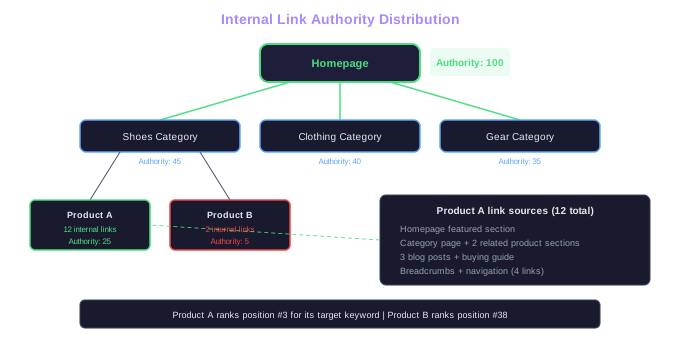
Every page on your site accumulates authority from external backlinks, brand searches, and user engagement signals. Internal links are the mechanism that distributes this authority throughout your store. When your homepage, typically your most authoritative page, links to a category page, it passes a portion of its authority to that category. When the category links to individual products, authority flows further down the hierarchy. Without deliberate internal linking, deep product pages can become orphaned, receiving no authority and struggling to rank.
Search engines use internal links to understand the relative importance of pages within your site. A product page that receives internal links from the homepage, its category page, related product sections, blog posts, and buying guides signals to Google that it is an important page worthy of higher rankings. Conversely, a product page linked only from its parent category sits in relative obscurity, making it harder to rank for competitive keywords.
The concept of link equity distribution means that every internal link you add or remove changes the authority balance across your entire site. Adding fifty internal links to a single product page concentrates authority there but dilutes it from other pages. The goal is a balanced distribution that matches your business priorities, your best-selling products and highest-margin categories should receive the most internal links, while lower-priority pages receive fewer but still sufficient links for crawlability.
Link Count vs Rank
A product with 12 internal links from the homepage, category, blog posts, and related sections typically ranks in the top 5. The same product with only 2 links from its parent category often sits beyond position 30.
Contextual Internal Links on Product Pages
Beyond navigation, product pages offer multiple opportunities for contextual internal links, links placed within page content that connect related products, categories, and informational resources. These contextual links carry more SEO weight than navigational links because search engines view them as editorial endorsements of the linked page's relevance.
Related products sections are the most common contextual linking opportunity on product pages. "You might also like," "Customers also bought," and "Complete the look" sections link to complementary or similar products, creating a web of internal links across your product catalog. For SEO, these links help distribute authority to products that may not receive many external backlinks. For conversion, they increase page views per session and average order value by exposing shoppers to additional products.
Product descriptions themselves should include contextual links where natural. If a jacket description mentions that it pairs well with a specific pair of boots, link to that boot product page. If a skincare product references that it works best as part of a routine, link to the other products in that routine. These editorial links within body content are the most valuable type of internal link for SEO because they are surrounded by relevant context that helps Google understand the relationship between the linked pages.
Category cross-links on product pages help shoppers discover related categories. A product page for running shoes might include links to "Running Socks," "Running Shorts," and "GPS Running Watches" categories. Aligning these links with your overall site architecture ensures they reinforce rather than confuse your hierarchy. These cross-category links break the siloed structure that many ecommerce sites default to, where products only link within their own category tree.
Blog and Content Hub Internal Linking
If your ecommerce store has a blog or content section, it represents a powerful internal linking opportunity that most stores underutilize. Blog posts targeting informational keywords can link to relevant product and category pages, funneling topical authority from content pages to commercial pages. This creates a bridge between the informational and transactional parts of your site.
Every blog post about a product category should link to the relevant category page and two to three specific products mentioned in the content. A blog post titled "How to Choose the Right Running Shoe for Your Foot Type" should link to your running shoes category page and specific products recommended within the article. These links pass authority from the blog post to your commercial pages while also providing a natural shopping path for readers ready to buy.
Create content hub pages that act as pillar content linking out to multiple related blog posts and product categories. A hub page titled "Complete Guide to Home Office Setup" could link to blog posts about ergonomic chairs, standing desks, monitor placement, and lighting, while also linking to the corresponding product categories. The hub page accumulates authority from all the blog posts linking back to it, and it distributes that authority to product pages through its outbound links.
Reverse the flow as well, add links from product and category pages back to relevant blog content. A product page for an ergonomic chair could include a link to "How to Set Up Your Ergonomic Chair for Maximum Comfort" in a tips section. This bidirectional linking creates topical clusters that strengthen the relevance signals for both your content and product pages, helping both types of pages rank higher for their respective keyword targets.
Audit your existing blog content for missing internal links to product pages. Many stores have dozens of blog posts that mention products without linking to them. A single afternoon spent adding product links to existing blog content can produce measurable ranking improvements within weeks.
Anchor Text Optimization for Internal Links
The anchor text of internal links, the clickable text that forms the link, tells both users and search engines what the destination page is about. Unlike external backlinks where you have little control over anchor text, internal links give you full control to use keyword-rich, descriptive anchor text that reinforces the target page's topic.
For product links, use the product name or a descriptive variation as the anchor text. Instead of "click here" or "learn more," link with text like "Men's Waterproof Hiking Boots" or "our best-selling leather wallet." This passes clear topical signals to the linked page and helps Google understand what that page should rank for. Descriptive anchor text also helps users understand where the link will take them, reducing confusion and improving the user experience.
For category links, use the category keyword as the anchor text. If your category page targets "women's running shoes," ensure that internal links pointing to it use that phrase or close variations like "running shoes for women" or "women's running footwear." Consistency in anchor text across multiple internal links reinforces the page's keyword targeting and signals to Google that the page is the authoritative resource for that topic on your site.
Avoid over-optimizing anchor text with exact-match keywords on every single internal link. While internal anchor text optimization carries less risk than external link manipulation, an unnatural pattern of identical anchor text across hundreds of links can look manipulative. Mix exact-match keywords with branded anchors, partial-match variations, and natural phrases. The goal is to be descriptive and helpful rather than to game the algorithm.
Never use generic anchor text like "click here," "read more," or "shop now" for your most important internal links. These phrases provide zero keyword context to search engines and waste a valuable signal opportunity. Save generic anchors for supplementary links like policy pages or navigation elements where keyword targeting is unnecessary.
Anchor Text Balance
Mix exact-match keywords (40%), partial-match variations (30%), and natural phrases (30%) in your internal anchor text. Using identical anchor text across hundreds of links looks manipulative and reduces effectiveness.
Auditing and Scaling Internal Links
Internal link audits should be a regular part of your ecommerce SEO maintenance. Start by crawling your site with Screaming Frog, Ahrefs, or Sitebulb to generate an internal link report. Identify orphaned pages, those with zero or very few internal links, and prioritize adding links to them from relevant pages. Our internal link analyzer can help you spot these gaps quickly. In large ecommerce catalogs, orphaned product pages are extremely common, especially for new products that have been added without updating related product sections or blog content.
Analyze internal link distribution across your site to ensure your most important pages receive the most links. Export the internal link count per page and compare it to the page's revenue contribution or strategic importance. If your best-selling product receives only three internal links while a low-priority page receives fifteen, your link distribution is misaligned with your business goals.
For stores with thousands of products, automate internal linking where possible. Related products algorithms, "recently viewed" sections, and "bought together" features create dynamic internal links that scale with your catalog. However, do not rely solely on automated linking, manual editorial links in blog posts, buying guides, and category descriptions are higher quality and should supplement automated systems.
Set up a process for maintaining internal links as your catalog evolves. When products are discontinued, ensure the internal links pointing to those pages are updated or the pages redirect properly. When new products launch, add them to related product sections, relevant blog posts, and category pages. A living internal linking strategy that evolves with your catalog prevents the gradual accumulation of broken links and orphaned pages that degrade site quality over time.
Track the impact of internal linking changes through Google Search Console. Monitor crawl stats to see if Google is discovering and indexing more pages after your linking improvements. Track ranking changes for pages that received new internal links, typically expecting to see movement within four to eight weeks of implementation.
Build an internal linking checklist for product launches. Every new product should receive links from its category page, at least two related product sections, and any relevant blog posts or buying guides. Making internal linking part of your product launch workflow prevents orphaned pages from accumulating in your catalog.
Free Tools & Resources
Try our free SEO tools
Work Together With SEO Experts who understand ecommerce
World’s first Ecom-founded SEO agency