Link Building
8 min readBroken Link Building
Broken link building turns dead links on other websites into live backlinks pointing to your ecommerce store. Every website accumulates broken outbound links over time as pages are deleted, domains expire, or URLs change. By finding these dead links on relevant sites and offering your content as a replacement, you provide genuine value to webmasters while earning high-quality backlinks, making it one of the most ethical and effective [link building](/link-building) strategies available.
In this guide
Finding Broken Links on Relevant Sites
The success of broken link building depends entirely on where you look. Random broken links on unrelated sites waste your time. Focus your search on resource pages, buying guides, and blog posts within your ecommerce niche, these pages are most likely to accept a replacement link to your store's content.
Start with resource pages in your niche. Google search operators like "your niche + useful resources," "your product category + recommended links," or "your niche + helpful sites" surface pages that curate links to external content. These resource pages naturally accumulate broken links as the sites they reference go offline or restructure.
Use Ahrefs' Broken Link Checker or the Check My Links browser extension to scan resource pages for dead outbound links. In Ahrefs, you can also use the Broken Backlinks report on competing domains to find pages that used to link to content similar to yours but now point to 404 errors. This approach is particularly powerful because the linking page already demonstrated editorial interest in your topic. Running a competitor backlink analysis surfaces the highest-value broken link opportunities in your niche.
Another effective technique is to identify defunct competitors or industry sites that have gone offline. When a competitor closes their store or lets their domain expire, every backlink they earned becomes a broken link. Tools like the Wayback Machine help you understand what content used to exist on those dead pages, allowing you to create replacement content that matches what the linking sites originally referenced.
Competitor Goldmine
When a competitor closes their store or lets their domain expire, every backlink they earned becomes a broken link opportunity. A single defunct competitor with 200 referring domains can fuel months of outreach campaigns.
Set up Ahrefs alerts for new broken backlinks on your top five competitors. When a competitor's page goes down, you will be notified immediately and can reach out to the linking sites before anyone else offers a replacement.
Creating Replacement Content That Matches
Offering a random product page as a replacement for a broken link will fail. Webmasters linked to the original content for a reason, your replacement must serve the same purpose and provide equal or greater value to their audience.
Use the Wayback Machine to view archived versions of the dead page. Understand what information it provided, how comprehensive it was, and why other sites found it worth linking to. Your replacement content should cover the same topic with similar depth, but updated data, better organization, or additional insights that make it genuinely superior.
For ecommerce sites, the most common replacement content types are buying guides, product comparison articles, industry statistics pages, and how-to guides related to your product category. These content types naturally attract links because they serve as reference material for bloggers and journalists. A buying guide that compares features across product categories provides the same informational value that the dead page once offered.
Do not try to replace informational content with product pages. If the broken link pointed to an article about choosing the right running shoes, your replacement should be a comprehensive guide to running shoe selection, not your product listing for running shoes. The replacement content can internally link to your products, but the page itself must be editorially valuable enough to justify the link placement.
Build a library of five to ten comprehensive resource pages on your site covering the major topics in your niche. These evergreen assets serve as ready-made replacements whenever you discover broken links in your industry, eliminating the need to create new content for each campaign.
Outreach Templates That Get Results
Broken link building outreach has a higher success rate than cold outreach because you are solving a real problem. Your email notifies the webmaster of a broken link on their site and offers a working alternative, this is genuinely helpful, not self-promotional. Frame your email accordingly.
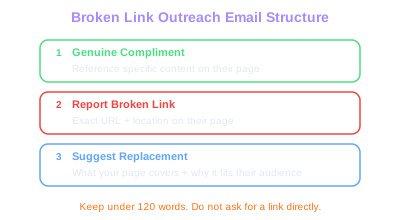
The most effective broken link outreach email follows a three-part structure. First, open with a specific, genuine compliment about the page you found the broken link on, this proves you actually visited their site. Second, point out the broken link by providing the exact URL that is returning a 404 error and describe where on their page it appears. Third, suggest your content as a replacement by explaining what it covers and why it would be a good fit for their audience.
Keep the email under 120 words. Webmasters are busy and a concise, helpful email outperforms a long sales pitch every time. Do not ask for a link directly, simply suggest your page as a potential replacement and let the webmaster decide. This indirect approach feels less transactional and produces higher conversion rates. For more outreach templates and follow-up strategies, see email outreach for links.
Avoid sending templated emails that mention multiple broken links at once. While it might seem efficient, webmasters perceive bulk broken link notifications as automated spam. Report one specific broken link per email and keep the tone genuinely helpful. If the same page has multiple broken links, mention only the one most relevant to your content.
Higher Success Rate
Broken link outreach converts better than cold outreach because you are solving a real problem. One specific broken link per email outperforms bulk notifications that webmasters perceive as automated spam.
Tools and Workflows for Broken Link Building
Efficient broken link building requires the right tools and a systematic workflow. Without automation at the discovery stage, the process is too slow to generate meaningful results for an ecommerce site.
Ahrefs is the primary tool for broken link building at scale. The Content Explorer feature lets you find pages in your niche that no longer exist by searching for relevant keywords and filtering for 404 pages. The Broken Backlinks report shows you exactly which pages link to dead content in your topic area, along with the anchor text and domain rating of each linking page.
For on-page scanning, the Check My Links Chrome extension highlights broken links on any page you visit, making manual prospecting faster. Screaming Frog can crawl entire websites and export lists of broken outbound links, which is useful when you want to systematically scan a target site's resource section.
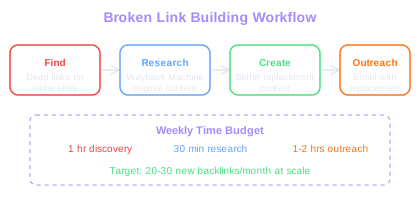
Build a workflow around weekly prospecting sessions. Dedicate two to three hours per week to finding broken link opportunities: one hour on discovery using Ahrefs and Google operators, 30 minutes checking the Wayback Machine for the original content, and one to two hours on personalized outreach. Track every prospect in a spreadsheet with columns for the broken URL, the linking page, the webmaster's contact email, the replacement content URL, the outreach date, and the response status.
Batch similar opportunities together. If you find five resource pages in your niche that all link to the same dead page, you can use one piece of replacement content and send five personalized outreach emails, maximizing the return on your content creation investment.
Create a saved search in Ahrefs Content Explorer for your top niche keywords filtered to 404 pages. Check this saved search weekly, new broken link opportunities appear constantly as sites restructure and pages go offline.
Scaling the Broken Link Building Process
Broken link building can be scaled from a handful of links per month to a consistent pipeline of 20-30 new backlinks monthly, but scaling requires systematization of every step: discovery, content creation, outreach, and follow-up.
At the discovery stage, scale by expanding your keyword universe. Most ecommerce sites start with their primary product keywords, but the biggest opportunity pool comes from adjacent topics. A store selling kitchen equipment should not only look for broken links about knives and cookware, but also about cooking techniques, recipe resources, food safety guides, and kitchen design articles. Each adjacent topic opens a new vein of broken link opportunities.
Scale content creation by building modular resource pages. Instead of creating a new page for every broken link opportunity, build comprehensive pillar content that covers broad topics in your niche. A 3,000-word ultimate guide to choosing kitchen knives can serve as the replacement for dozens of different broken links that touched on various aspects of knife selection, steel types, or kitchen tool recommendations.
Scale outreach by hiring a virtual assistant to handle prospecting and initial outreach under your guidance. Train them on your quality criteria, provide your email templates, and have them report findings for your review before sending. The VA handles the mechanical work, finding broken links, locating contact emails, and drafting personalized emails, while you maintain quality control over target selection and content decisions.
Track conversion rates by content type and niche segment. Over time, you will discover that certain types of replacement content convert at 20-30% while others barely reach 5%. Double down on the content formats and niche topics that produce the highest link conversion rates.
Aim for a broken link building pipeline that operates on a four-week cycle: Week 1 for discovery and prospecting, Week 2 for content creation or updates, Week 3 for outreach, and Week 4 for follow-up. This rhythm creates predictable, consistent link acquisition that compounds over time.
Free Tools & Resources
Try our free SEO tools
Work Together With SEO Experts who understand ecommerce
World’s first Ecom-founded SEO agency