Keyword Research
9 min readLong-Tail Keywords for Products
The math behind long-tail ecommerce SEO is straightforward: 500 product pages, each bringing 10 organic visits per day at a 5% conversion rate, equals 25 daily sales from search alone. Here is how to find and capture those long-tail opportunities across your entire product catalog.
In this guide
Long-Tail Math for Ecommerce
Most store owners fixate on a handful of high-volume keywords. Meanwhile, the real revenue opportunity sits in aggregate long-tail traffic. Let's look at realistic numbers.
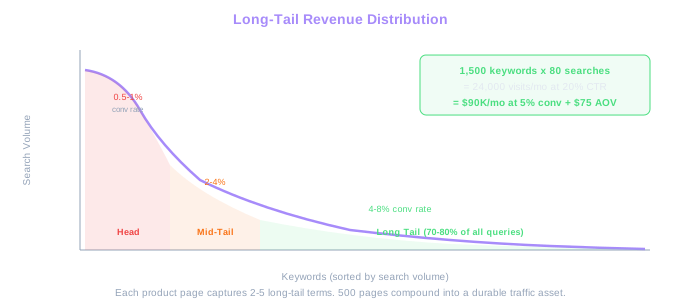
A store with 500 product pages can reasonably target 2-5 long-tail keywords per page. That's 1,000-2,500 keyword targets. Each long-tail keyword might get only 20-200 searches per month, but with a position 1-3 ranking, you can capture 15-30% of that traffic. And because long-tail searches are highly specific, conversion rates run 4-8% compared to 0.5-1% for head terms.
Run the math: 1,500 long-tail keywords averaging 80 searches per month, with a 20% click-through rate at positions 1-3, yields 24,000 monthly visits. At a 5% conversion rate and a $75 average order value, that's $90,000 in monthly revenue, from terms that most competitors ignore entirely.
The compounding effect is what makes this strategy powerful. Each new product page you add captures more long-tail terms. As your domain authority grows, those pages rank faster and for more variations. Our broader guide to keyword research for ecommerce explains how to build this foundation. A store that systematically optimizes product pages for long-tail keywords builds an organic traffic asset that competitors can't easily replicate.
Compounding Revenue
A home goods store optimized 800 products over 6 months using wave-based rollout. Month-over-month organic revenue grew 12% on average, and by month 8 organic search was their second-largest revenue channel.
Finding Long-Tail Opportunities in Product Attributes
Your product data is a goldmine of long-tail keywords hiding in plain sight. Every attribute, size, color, material, weight, compatibility, use case, combines with the product type to create a searchable query.
Take a product like a camping sleeping bag. The base keyword is "camping sleeping bag" (high volume, brutal competition). But the attributes generate dozens of long-tail terms: "3-season sleeping bag rated 20 degrees," "ultralight mummy sleeping bag under 2 lbs," "wide sleeping bag for side sleepers," "down sleeping bag packable for backpacking." Each of these terms has lower volume but dramatically higher purchase intent.
The systematic approach: export your product data with all attributes into a spreadsheet. Create keyword formulas that combine product type + attribute 1, product type + attribute 1 + attribute 2, and so on. Then validate these against actual search volume using Ahrefs, Semrush, or Google Keyword Planner.
Don't overlook compatibility and accessory queries. "iPhone 15 Pro Max screen protector tempered glass" is a long-tail keyword built entirely from product compatibility attributes. For stores selling accessories, parts, or compatible products, these queries represent some of the highest-converting traffic available.
Export your product feed and create a keyword matrix: product type in rows, attributes in columns. The intersections generate your long-tail keyword targets. A store with 10 product types and 8 attributes per type can generate 80+ keyword variations per product.
Optimizing Product Pages Without Creating Thin Content
The challenge with long-tail optimization is avoiding thin content, pages that target specific keywords but lack enough substance to rank. Google's quality standards demand that every page provides genuine value, not just keyword matches.
The solution is layered content. Start with a unique product description (150-300 words) that naturally incorporates your primary and secondary long-tail keywords. This replaces the manufacturer's boilerplate text that every other retailer uses.
Add a specifications section that lists every product attribute in a structured format. This serves both SEO (each spec is a keyword signal) and user experience (shoppers compare specs before buying). Use a definition list or table format that search engines can easily parse.
Include a use-case section (100-200 words) that answers "who is this product for?" and "when should you use it?" This naturally incorporates use-case modifiers ("for hiking," "for beginners," "for professional use") that drive long-tail traffic.
Finally, user-generated content, reviews, Q&A sections, and customer photos, adds unique, keyword-rich text to every product page without any content creation effort on your part. A product page with 20+ reviews has more indexable text than one with just a description, and that text includes the exact language real buyers use when searching. For more on optimizing these pages, see our product page SEO topic.
The Revenue Stacking Strategy
Revenue stacking means building organic traffic incrementally, product page by product page, until the cumulative long-tail traffic becomes your largest revenue channel. Rather than betting everything on ranking for one or two competitive head terms, you spread your SEO investment across your entire catalog.
The process works in waves. Wave one: optimize your top 50 products by revenue, the ones that already sell well. Write unique descriptions, add structured specifications, optimize titles and meta descriptions for their primary long-tail keywords. This usually takes 2-4 weeks and yields measurable traffic increases within 60-90 days.
Wave two: expand to your next 100 products, applying the same template. At this point, you'll have a proven content format that you can scale with a content writer or a writing team. The cost per page drops because the template is established.
Wave three and beyond: work through your remaining catalog in batches of 50-100 products. By now, the cumulative effect is visible, your overall organic traffic curve is climbing steadily, and the revenue attribution makes the ROI case clear.
A home goods store we worked with followed this exact process across 800 products over six months. Month-over-month organic revenue growth averaged 12%, and by month eight, organic search had become their second-largest revenue channel behind paid advertising.
Tools for Finding Product-Level Long-Tails
Google Search Console is the starting point. Filter by pages containing "/product/" or your product URL pattern. The queries report shows exactly which long-tail terms already drive impressions to your product pages. Many of these will be terms you hadn't considered, real language from real shoppers.
Ahrefs and Semrush both let you analyze individual product page URLs. Enter a product page URL and see which keywords it ranks for, which keywords it could rank for with optimization, and which related keywords the page doesn't target at all. Their keyword suggestion features also generate long-tail ideas from your seed terms.
Amazon search suggestions are pure gold for product-level long-tails. Type your product name into Amazon's search bar and note the autocomplete suggestions, these come from actual purchase-intent searches. Tools like Helium 10 and Jungle Scout aggregate this data at scale.
Google Shopping search terms (if you run Google Ads) provide another rich source. These are the exact queries that triggered your shopping ads, filtered for purchase intent by default. Export your search terms report and mine it for organic keyword targets.
Your own site search data rounds out the picture. The terms shoppers type into your internal search bar reveal demand for specific attributes, variations, and use cases that you can target with product page optimization. For more keyword finding techniques, check our ecommerce SEO keywords guide.
Set up a monthly workflow: pull GSC query data for product pages, extract Amazon suggestions for your top sellers, and review site search logs. Feed the results into your optimization queue. Consistency beats one-time efforts every time.
Scaling Long-Tail Optimization Across Large Catalogs
Stores with 1,000+ products can't write custom content for every page overnight. The key is a templatized approach that balances quality with speed.
Create a product page content template for each major category. The template defines which sections appear on the page, which attributes get featured prominently, and where long-tail keywords should be incorporated. A template for electronics might emphasize compatibility and technical specs, while one for clothing focuses on sizing, materials, and care instructions.
Use your product data feed to auto-generate portions of the content. Specification tables, key feature bullet points, and compatibility notices can all be built from structured product data. This gives every page a baseline of keyword-rich content without manual writing.
Reserve manual content creation for the highest-value pages, your top 100-200 products by revenue. These get custom descriptions, detailed use-case sections, and hand-written buying guidance. The rest of your catalog gets the template treatment, which is still a massive improvement over generic manufacturer descriptions.
Track results at the template level. If a particular template consistently produces pages that rank and convert, roll it out more aggressively. If a template underperforms, refine it before applying it to more products.
Free Tools & Resources
Try our free SEO tools
Work Together With SEO Experts who understand ecommerce
World’s first Ecom-founded SEO agency