Keyword Research
8 min readBuyer Intent vs. Search Volume
A keyword with 50 monthly searches and a 6% conversion rate generates more revenue than one with 10,000 searches and a 0.1% conversion rate. For ecommerce stores, understanding buyer intent is the single most profitable skill in keyword research.
In this guide
Why Volume Alone Is Misleading
Search volume tells you how many people type a query into Google each month. It says nothing about whether those people want to buy, compare, learn, or just browse. A query like "leather jacket" gets around 135,000 monthly searches, but the intent behind it ranges from fashion inspiration to purchase research to looking for care instructions.
Contrast that with "buy schott nyc perfecto leather jacket size 42" at maybe 30 searches per month. Every single person typing that query is ready to hand over their credit card. The conversion rate gap between these two queries can be 20x or more.
Most keyword tools sort by volume by default. This trains store owners to chase the biggest numbers, which often means the vaguest, most competitive, and least converting terms. Flipping this default, sorting by estimated revenue instead, changes which keywords you prioritize entirely. Our topic on search intent for ecommerce covers the foundational framework behind these intent categories.
The Revenue-Per-Keyword Calculation
Here is the formula we use for every keyword decision: Revenue = Monthly Search Volume x Expected CTR x Conversion Rate x Average Order Value.
Let's run two real examples. Keyword A: "running shoes" with 201,000 monthly searches. If you rank position 5 (roughly 4% CTR), with a 0.3% conversion rate and a $120 AOV, that gives you: 201,000 x 0.04 x 0.003 x 120 = $2,894/month.
Keyword B: "brooks ghost 15 women's size 9" with 320 monthly searches. At position 2 (roughly 12% CTR), with a 7% conversion rate and the same $120 AOV, that gives you: 320 x 0.12 x 0.07 x 120 = $322/month from a single long-tail keyword.
Now consider this: your store probably has 500+ product pages. If each captures just two or three long-tail keywords like Keyword B, the total revenue from long-tail terms dwarfs what you'd get from the single head term, with far less competition and much faster ranking timelines.
Build a spreadsheet that calculates revenue per keyword automatically. Plug in your actual conversion rates from Google Analytics by page type, product pages typically convert 3-5x higher than category pages for organic traffic.
How to Score Keywords by Purchase Intent
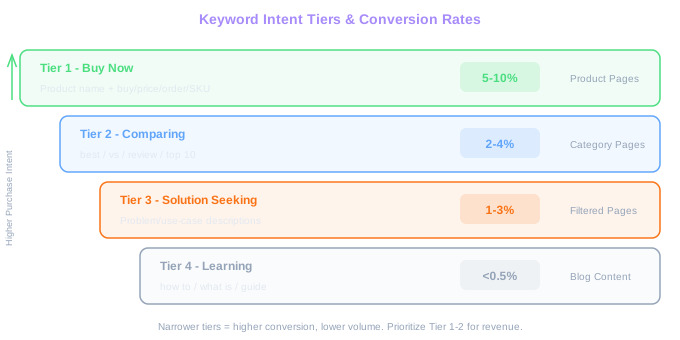
We classify ecommerce keywords into four intent tiers. Tier 1 (highest intent): queries containing specific product names, SKUs, model numbers, or exact product attributes plus "buy," "order," or "price." These convert at 5-10%.
Tier 2 (comparison intent): queries with modifiers like "best," "vs," "review," "top 10," or "compared to." These shoppers have purchase intent but haven't decided on a specific product. Conversion rates run 2-4%, and the winning move is category pages or buying guides that funnel traffic to products.
Tier 3 (solution intent): queries describing a problem or use case, like "waterproof jacket for hiking in rain" or "comfortable office chair for back pain." The searcher wants a product but doesn't know which category to look in. Conversion rates run 1-3%, and filtered category pages work well here.
Tier 4 (informational): queries starting with "how to," "what is," "why does," or general topic terms. Conversion rates are below 0.5%. These have SEO value for building topical authority, but they should never be prioritized over Tier 1-3 keywords unless you've already captured the commercial terms.
Intent vs. Revenue
A furniture store's product page for a specific oak table ranked for 23 long-tail Tier 1 keywords (380 visits/mo) and generated $8,900/mo, while their head-term category page (2,800 visits/mo) produced only $4,200/mo.
Commercial Modifiers That Signal Purchase Intent
Certain words added to a base keyword dramatically increase purchase probability. We track these modifiers in every keyword research project because they're the fastest way to identify high-converting terms that competitors overlook.
Transactional modifiers include: buy, order, purchase, shop, deal, discount, coupon, sale, free shipping, price, cost, cheap, affordable, and where to buy. When someone adds "buy" or "price" to a product query, their intent is unmistakable.
Comparison modifiers include: best, top, vs, versus, compared, review, reviews, rated, recommended, and alternative to. These signal a shopper who is close to buying but weighing options. Category pages and comparison content capture this traffic effectively.
Specification modifiers include: size, color, material, model number, year, dimensions, weight, and compatibility terms. These narrow the searcher to a very specific product variant and convert exceptionally well when matched to properly optimized product pages.
Use-case modifiers like "for hiking," "for office," "for kids," "for beginners" reveal the buyer's situation and let you match them to the right product subset. These work well with filtered category pages.
Create a modifier library for your niche. List every transactional, comparison, specification, and use-case modifier relevant to your products. Cross-reference these with your seed keywords to generate hundreds of high-intent long-tail variations.
Real Examples: Low Volume Beating High Volume
A home furniture client of ours ranked on page one for "dining table" (74,000 monthly searches). The page got 2,800 organic visits per month but generated only $4,200 in attributable revenue, a revenue-per-visit of $1.50.
Meanwhile, their product page for a specific extendable oak dining table ranked for 23 long-tail variations averaging 40-150 searches each. Combined monthly traffic: 380 visits. Combined monthly revenue: $8,900, a revenue-per-visit of $23.42.
We see this pattern consistently. An outdoor gear store generates 60% of its organic revenue from keywords with fewer than 500 monthly searches each. A supplement brand gets its highest ROI from branded ingredient queries that most keyword tools flag as "low volume."
The takeaway is not that high-volume keywords are worthless, they build brand visibility and capture top-of-funnel traffic. But for revenue generation, the long tail with clear purchase intent outperforms head terms almost every time. The strategic move is allocating your effort proportionally: 70% of your SEO work should target the terms that drive 70% of your revenue.
Putting Intent Analysis Into Practice
Start by pulling your top 100 organic landing pages by revenue from analytics. For each page, identify the primary keyword driving traffic (GSC makes this straightforward). Tag each keyword with its intent tier.
You will likely find that your highest-revenue pages are driven by Tier 1 and Tier 2 keywords, even if those pages don't get the most traffic. This confirms where to focus your optimization efforts.
Next, look at your keyword research pipeline. Every new keyword target should go through the intent scoring process before it gets prioritized. A Tier 1 keyword with 200 monthly searches should be worked on before a Tier 4 keyword with 5,000 monthly searches.
Finally, use intent analysis to improve existing pages. If a category page ranks for a Tier 2 keyword but converts poorly, check whether the page content matches comparison intent, does it help shoppers decide between options, or does it just list products? Aligning page content with keyword intent is one of the fastest ways to increase conversion rates without additional traffic. Once you have scored your keywords, keyword mapping for stores helps you assign each term to the right page. For a complete overview of these strategies, see our ecommerce SEO strategy guide.
Free Tools & Resources
Try our free SEO tools
Work Together With SEO Experts who understand ecommerce
World’s first Ecom-founded SEO agency