Keyword Research
8 min readCompetitor Keyword Analysis
Your competitors have already done keyword research for you, they just don't know it. By analyzing which keywords drive traffic to competing stores, you can identify gaps in your own strategy and find proven opportunities that are already generating revenue in your market. This process builds on the fundamentals covered in [keyword research for ecommerce](/academy/keyword-research-for-ecommerce).
In this guide
Identifying Your Real SEO Competitors
Your SEO competitors are not necessarily your business competitors. A local shoe store might compete with Nike for customers, but in search results, their real competitors are other mid-size online retailers ranking for the same product keywords.
To find your actual SEO competitors, search for your top 10 category-level keywords and note which domains consistently appear on page one. These are the sites you're fighting for clicks. Some will be direct business competitors; others might be marketplaces, review sites, or niche retailers you hadn't considered.
Ahrefs and Semrush both have competitor discovery features that automate this process. Enter your domain and they'll show you which sites share the most keyword overlap with yours. The "competing domains" report typically reveals 5-10 sites you should be tracking regularly.
Focus on competitors who are a step ahead of you, not the market leaders with massive domain authority. If you're a 2-year-old store with 500 products, analyzing Amazon or Walmart teaches you nothing actionable. Instead, analyze the store with 1,000 products and slightly better rankings, their strategy is within your reach.
Running a Keyword Gap Analysis
A keyword gap analysis compares your keyword profile against one or more competitors to find terms they rank for that you don't. This is one of the highest-ROI activities in ecommerce SEO because it reveals proven demand, if your competitor ranks and gets traffic for a keyword, the opportunity is validated.
In Ahrefs, go to Site Explorer, enter your domain, then navigate to Content Gap. Enter 2-3 competitor domains and the tool will show keywords those competitors rank for in the top 10 that your site doesn't rank for at all. Filter the results by search volume (above 50), by keyword difficulty (under 40 for quick wins), and by position (competitor is top 5).
In Semrush, the equivalent feature is Keyword Gap under Competitive Research. The interface lets you compare up to five domains simultaneously, with filters for keyword type, position ranges, and volume brackets.
The output is typically a list of hundreds or thousands of keywords. Don't try to tackle them all. Sort by search volume, apply your intent scoring (prioritize Tier 1-2 commercial keywords), and look for clusters of related terms. A cluster like "organic cotton t-shirts," "organic cotton shirts women," and "best organic cotton clothing" points to a category gap you can address with a single well-structured page. Our keyword cannibalization checker can help you verify that these new pages won't conflict with existing content.
Run gap analysis against each competitor individually, not all at once. Different competitors will reveal different opportunity clusters. A fashion competitor might show you apparel keywords you're missing, while a home goods competitor reveals decor terms you hadn't considered.
Finding Keywords Competitors Rank For That You Don't
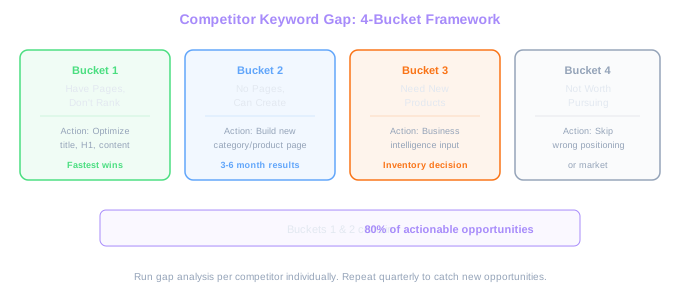
The gap analysis gives you the raw list, but turning it into action requires categorization. We sort competitor keywords into four buckets.
Bucket one: keywords you have pages for but don't rank. You already have a product or category page that should target this keyword but it doesn't appear in the top 100. These are optimization opportunities, update the existing page's title, H1, and content to better target the term.
Bucket two: keywords you don't have pages for but could create. Your competitor has a category page for "wireless earbuds for running" and you sell running earbuds but don't have a dedicated category page for them. Create the page.
Bucket three: keywords requiring new products or product lines. Your competitor ranks for products you don't carry. This is business intelligence, not just SEO data, it tells you what to stock or what new products to develop.
Bucket four: keywords not worth pursuing. Some competitor keywords don't align with your business model, target market, or product range. A competitor might rank for "cheap" modifiers while your brand positions as premium. Skip these.
The first two buckets are where you'll find 80% of your actionable opportunities. Bucket one is fastest to implement (optimize existing pages), while bucket two requires new page creation but typically yields results within 3-6 months.
Gap Analysis ROI
Run gap analysis against each competitor individually, not all at once. A fashion competitor reveals apparel keywords, a home goods competitor reveals decor terms. Quarterly repetition catches new entrants and shifting rankings.
Analyzing Competitor Content Strategies
Beyond individual keywords, look at how competitors structure their content to capture search traffic. Pull their top 50 organic pages by traffic from Ahrefs or Semrush. What page types dominate? How long is their category page copy? Do they use buying guides, comparison pages, or educational content to capture mid-funnel terms?
Pay special attention to category page content. If a competitor's category page for "men's running shoes" includes 500 words of buying guidance plus detailed filter options, and your equivalent page has just a product grid, that content gap is likely costing you rankings.
Check their internal linking patterns. Do they link from blog posts to category pages? Do product pages cross-link to related products? Does their navigation expose subcategory pages that you keep hidden? These structural choices directly affect keyword rankings and are easy to replicate on your own site.
Look at their content freshness signals. Are they updating category page copy seasonally? Are they adding new product comparison content monthly? A competitor who publishes a "best wireless headphones" guide updated quarterly signals that freshness matters for that keyword, and gives you a content calendar target.
Quarterly Gap Analysis Workflow
Competitor keyword analysis is not a one-time project. Markets shift, new competitors enter, and the keyword landscape changes every quarter. We run this workflow every 90 days for our ecommerce clients.
Week 1: update your competitor list. Check if any new domains have entered the top 10 for your primary keywords. Remove any that have dropped out. Pull fresh keyword gap data for each competitor.
Week 2: categorize new gap keywords into the four buckets. Prioritize bucket 1 (optimization) and bucket 2 (new page creation) opportunities. Estimate traffic potential for each using volume data and realistic CTR assumptions.
Week 3: create implementation tickets. For bucket 1 keywords, assign page optimization tasks with specific on-page changes. For bucket 2 keywords, scope new category or content page creation. Add timelines and owners to each ticket.
Week 4: review results from last quarter's gap analysis. Which pages were optimized? Did rankings improve? Which new pages were created? Are they indexing and gaining impressions? This retrospective ensures that gap analysis leads to action, not just analysis.
The quarterly cadence keeps you responsive to market changes without overwhelming your team with constant competitor monitoring. Between quarterly reviews, your keyword tracking tool handles the daily ranking fluctuations. For more on building a complete strategy from these insights, see our ecommerce SEO strategy guide.
Keep a running document of competitor insights, not just keywords, but content patterns, structural choices, and seasonal strategies. Over four quarters, this builds into a competitive intelligence asset that informs strategy decisions far beyond SEO.
Free Tools & Resources
Try our free SEO tools
Work Together With SEO Experts who understand ecommerce
World’s first Ecom-founded SEO agency