Content & Authority
10 min readTopical Authority for Ecommerce
Google rewards stores that demonstrate deep expertise within their product categories. Building topical authority means covering your niche so thoroughly that search engines, and shoppers, recognize you as the definitive resource. We break down how to structure content around product categories so your entire domain benefits.
In this guide
Building Topic Clusters Around Product Categories
A topic cluster groups all content related to a single product category around one central pillar page. The pillar page covers the broad topic, say, "espresso machines", and links out to detailed cluster pages about specific subtopics: grinder types, water temperature, cleaning routines, single vs dual boiler, milk frothing techniques.
For ecommerce, the pillar page is typically your main category page. The cluster pages can be a mix of subcategory pages, buying guides, how-to articles, and comparison posts. Every cluster page links back to the pillar, and the pillar links out to every cluster page. This creates a tightly connected web that Google can crawl efficiently.
We recommend mapping clusters before creating content. List every question a customer might ask before, during, and after purchasing a product in your category. Use keyword mapping for stores to assign each question to the right page. Group these questions into subtopics, and each subtopic becomes a cluster page. A typical product category generates 15-25 cluster page ideas.
Start with your top-revenue category. Map every customer question you can find, from pre-purchase research to post-purchase maintenance, and group them into 15-20 cluster page topics. Build this cluster first before expanding to other categories.
The Hub-and-Spoke Content Model
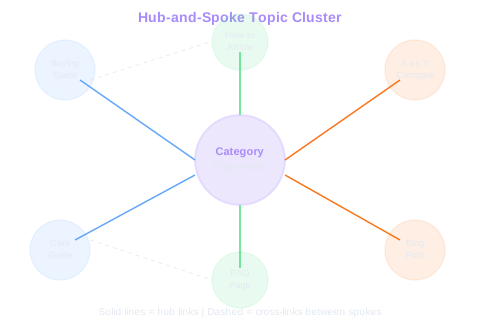
The hub-and-spoke model is the structural backbone of topical authority. Your category page is the hub. Spoke pages radiate outward, each targeting a specific long-tail query or subtopic. Internal links connect every spoke back to the hub and to related spokes.
What makes this model powerful for ecommerce is how it maps to the buying journey. Top-of-funnel spokes ("what is a pour-over coffee maker") attract researchers. Mid-funnel spokes ("pour-over vs French press") help shoppers narrow their options. Bottom-of-funnel spokes ("best pour-over coffee maker under 50 euros") drive purchase decisions. The hub page, your category page, catches everyone ready to browse and buy.
The linking structure is critical. Each spoke should link to the hub with descriptive anchor text that includes the category keyword. Spokes should also cross-link to related spokes where natural. The hub page should feature a content section that links to all relevant spokes, often organized as a resource grid or FAQ block at the bottom of the category page.
Cluster Size Guide
A typical product category generates 15-25 spoke page ideas. Start with your top-revenue category, map every customer question from pre-purchase to post-purchase, and build this cluster first before expanding.
How Google Evaluates Expertise in Your Niche
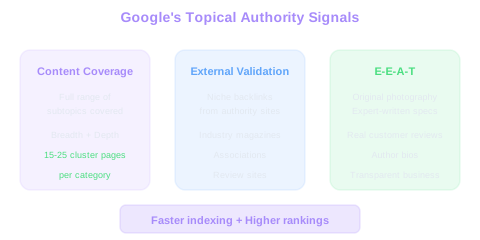
Google uses several proxy signals to assess whether a site is genuinely expert in its niche. The first is content coverage, do you have pages addressing the full range of queries within a topic, or just the high-volume ones? Sites that only publish content for competitive head terms appear shallow compared to those covering the full spectrum.
The second signal is external validation through backlinks. When other authoritative sites in your niche link to your content, that endorsement carries weight. Our ecommerce SEO guide explains how these signals compound over time. A hiking gear store that earns links from outdoor magazines, trail associations, and gear review sites builds a backlink profile that screams expertise.
The third signal is E-E-A-T: experience, expertise, authoritativeness, and trustworthiness. For ecommerce, this translates to original product photography, detailed specifications written by knowledgeable staff, genuine customer reviews, and transparent business information. Google's quality rater guidelines specifically mention that product pages should show first-hand experience with the items being sold.
Authority Compounds
New articles from topically authoritative stores reach page one within 2 weeks, while identical content on a new domain takes months. Once Google trusts your expertise, every new page you publish benefits.
Add author bios to your buying guides and blog posts. Link each bio to a profile page that lists the author's credentials and experience. This gives Google a clear E-E-A-T signal that real experts are creating your content.
Free Tools & Resources
Try our free SEO tools
Work Together With SEO Experts who understand ecommerce
World’s first Ecom-founded SEO agency